
Hand-Washing and Spot-Cleaning Pillows That Cannot Go in a Machine
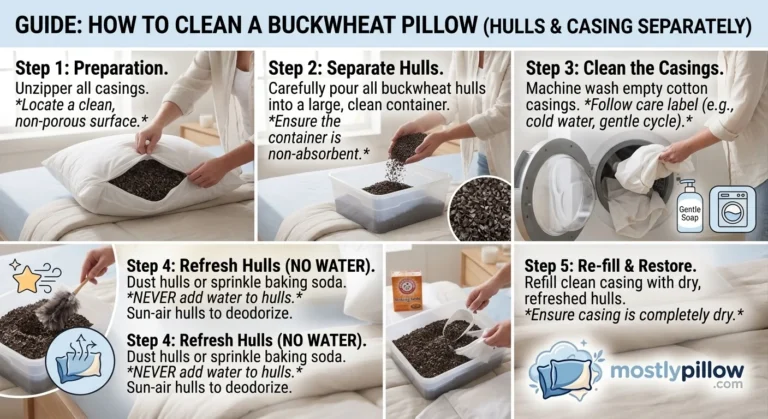
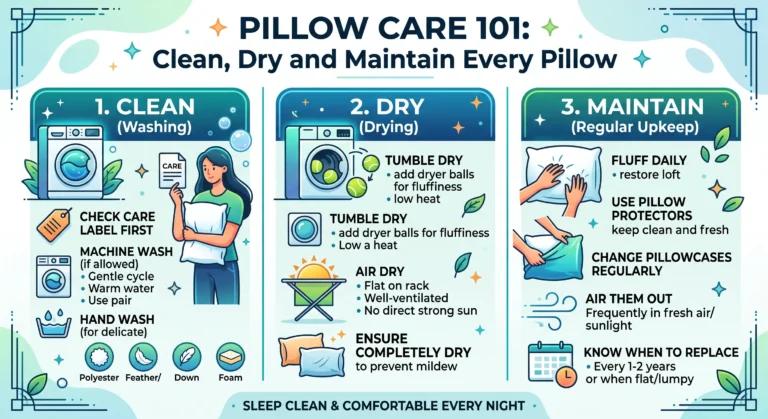
Hand washing a pillow means a bathtub or a large sink, cool to warm water, and only a few drops of mild detergent. Submerge the pillow, let it soak about ten minutes, then press and knead it rather than scrubbing. Rinse repeatedly until the water runs clear, because leftover detergent is what makes a hand-washed pillow feel stiff or smell faintly later. Press the water out between towels instead of wringing, then dry it flat in a well-ventilated spot, turning it regularly. Check your fill first: buckwheat should never be washed this way at all.
First, check whether hand washing is right for your pillow
Hand washing is the correct answer for some pillows, the only answer for others, and the wrong answer for a couple. Find your fill before you fill a tub.
| Your pillow | Is hand washing right? | Where to go |
|---|---|---|
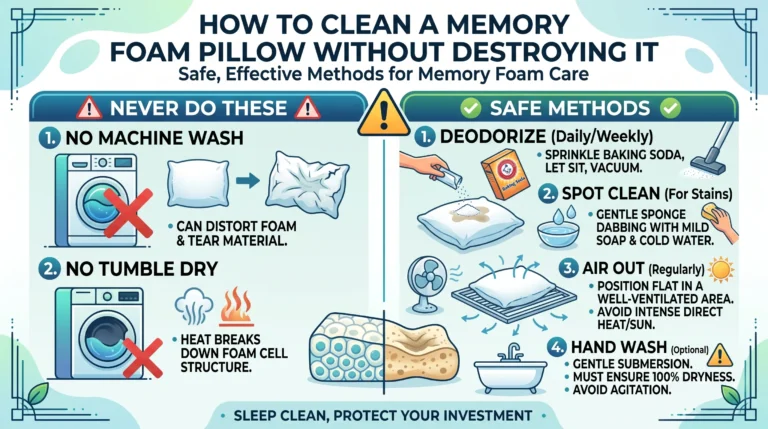
| Memory foam | Yes, and it is the only wet option | How to Clean a Memory Foam Pillow has the foam-specific handling |
| Latex | Yes, briefly and with support | How to Clean a Latex Pillow covers why the handling differs |
| Buckwheat | No, never | How to Clean a Buckwheat Pillow. The hulls must not get wet |
| Down or feather | Machine washing is easier and works better | How to Wash Down and Feather Pillows |
| Fiberfill or polyester | Machine is fine, hand wash if it will not fit the drum | How to Wash Pillows in a Washing Machine |
| Care label says do not machine wash | Yes, this page | Read on |
There are three reasons people end up here: the care label rules the machine out, the pillow is physically too large for the drum, or the fill is one that agitation would damage. The method below covers all three. The material-specific pages above cover what is different about each fill once you are at the tub.
What you need
- A bathtub, a large utility sink, or a basin big enough that the pillow can lie flat and still be surrounded by water
- A mild liquid detergent. A few drops, not a capful
- Two or three large, dry towels
- Somewhere flat and ventilated to dry the pillow, ideally a drying rack
That is the whole list. Nothing specialized, and no product that needs buying.
Step 1: set up the water
Fill the tub or sink with cool to warm water. Not hot. Hot water is harder on fills than people expect, and cool room-temperature water does a better job of preserving a pillow's shape and texture.
Add the detergent to the water and swirl it through before the pillow goes in. Detergent poured directly onto a dry pillow concentrates in one spot and is difficult to rinse out of that spot afterward.
Use a very small amount. This is the single most common mistake in hand washing, and everything that goes wrong later in the process traces back to it. There is no spin cycle here to help flush detergent out, so whatever you add you will have to remove by hand.
If the pillow's fabric or fill is at all delicate, test first: dab a small hidden area with the detergent solution, wait a few minutes, and check that nothing has discolored or stiffened.
Step 2: soak and knead
Lower the pillow in and press it down until it is fully submerged. Let it soak for about ten minutes. This is where most of the work actually happens, because time in the solution loosens residue without any mechanical stress at all.
Then work the pillow with your hands. Press down with flat palms, release, and let it draw the solution back in. Knead the fabric and fill gently, moving around the whole pillow so no section is missed. What you are doing is imitating what the washing machine's action would have provided, minus the violence.
Do not scrub, do not twist and do not wring. Those motions damage fill, and on foam and latex they cause tearing.
Give the corners and the center specific attention. Both are places where residue accumulates and where water tends not to reach on its own.
Step 3: rinse until the water runs clear
This is the step that separates a hand-washed pillow that feels good from one that feels stiff and smells faintly stale in a week.
Drain the tub completely. Refill with clean water. Press and release the pillow the same way you did while washing, so the clean water moves through it and pushes detergent out. Drain again.
Repeat this until the water stays clear and no suds appear when you press the pillow. That is the test. Not a number of rinses, not a set time: press the pillow under clean water and watch for cloudiness or foam. If you see either, you are not finished.
For an absorbent fill, expect this to take more passes than you assumed. Three or four is common. Detergent residue left in a fill is what makes it stiff and slightly crunchy when dry, and it holds onto smells rather than releasing them. Getting this right is the difference between a pillow that comes out fresh and one that comes out worse than it went in.
Step 4: get the water out without wringing
Drain the tub and press the pillow down against the bottom with your palms to expel as much water as you can while it is still supported. Work along the length of it.
Then lift it out flat, with both hands underneath, or slide a towel under it and lift the towel. A saturated pillow is heavy, and lifting it by one end puts all that weight on one section of fabric or fill. On foam and latex that causes tearing; on a stitched pillow it stresses the seams.
Lay the pillow on a large dry towel. Fold the towel over it, then press down firmly along its whole length, working from one end to the other. Do not roll and twist. Swap in a dry towel and repeat until the towels stop coming away soaked.
Never wring. Never twist. Both destroy fill and both are the instinctive thing to do with a wet object, which is why they need saying.
Step 5: drying a hand-washed pillow
A hand-washed pillow has had no spin cycle, so it starts far wetter than a machine-washed one. Budget more time than you would expect.
Lay it flat in a well-ventilated room, on a drying rack if you have one so air can reach it from below. If you are drying on a flat surface, put a dry towel underneath and change it when it becomes damp. Turn or flip the pillow every few hours so it dries evenly and no side sits compressed against a wet surface.
A fan pointed at the pillow makes a substantial difference and is the cheapest way to shorten the process. Heat is not: radiators, hairdryers and hot vents damage foam and latex and are not worth the time they save on anything else.
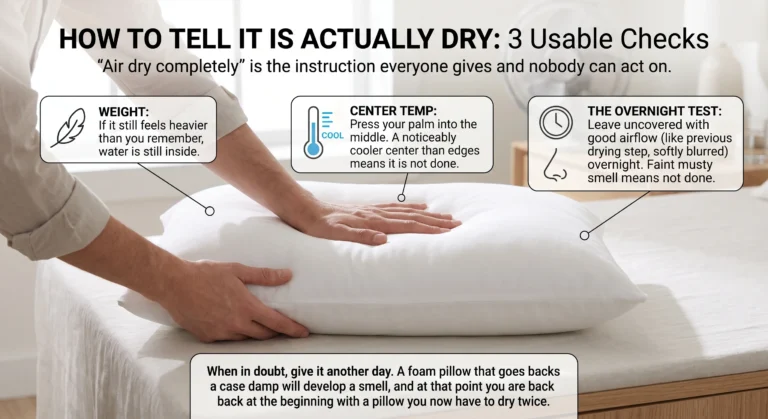
Before you put a pillowcase back on, check the center. Press your palm into the middle and hold it for a few seconds. If it feels cool relative to the edges, moisture is still evaporating and it needs longer. Fill-by-fill drying guidance is in How to Dry Pillows Without Ruining the Fill. If a smell has already appeared, that is almost always a drying problem rather than a cleaning one, and it needs more drying rather than more washing.
Spot cleaning, which is often the better answer
A lot of pillows that get hand washed had one mark on them. Washing an entire pillow to deal with a small stain means several days of drying and a real risk of getting the drying wrong, in exchange for cleaning an area the size of a coin.
For a localized mark:
- Mix a little mild detergent into warm water.
- Dampen a clean cloth and wring it out until it is barely damp.
- Dab the mark. Do not scrub. Work from the outside of the mark inward so you do not spread it.
- Follow with a second cloth dampened in plain water to lift the detergent.
- Blot dry with a towel, pressing to pull moisture out rather than rubbing.
- Let it air dry completely before the pillowcase goes back on.
This takes twenty minutes instead of three days and carries almost none of the risk.
Mistakes that cost you the pillow
| Mistake | What it causes |
|---|---|
| Too much detergent | Stiff fill, residue smell, many extra rinses |
| Stopping rinsing too early | The same, and it is not obvious until the pillow is dry |
| Hot water | Damage to down and to foam, and shrinkage in some shells |
| Wringing or twisting | Torn fill, damaged seams, permanent lumps |
| Lifting a wet pillow by one end | Tearing, especially in foam and latex |
| Drying it upright or folded | Uneven drying and a damp core |
| Putting it back damp | A musty smell, and the whole job to do again |
FAQ
How long does a hand-washed pillow take to dry?
Longer than a machine-washed one, because there is no spin cycle. Judge it by the center-temperature check rather than by the clock, and be prepared for it to take more than a day for dense fills.
Can I use the spin cycle just to get the water out?
Not for foam or latex, where the spin is the most damaging part of the machine. For a fiberfill pillow that simply did not fit the drum for washing, a spin is usually fine if it fits when compressed and wet.
Is a bathtub or a sink better?
A tub, if the pillow is a standard size or larger, because the pillow should be able to lie flat with water all around it. A large utility sink works for smaller pillows.
Can I hand wash a pillow that says dry clean only?
The label is the manufacturer's instruction and overrides general advice. Spot cleaning is the lower-risk option in that situation.
Do I really need to rinse that many times?
Yes. There is no rinse cycle doing it for you. The test is visual: press the pillow under clean water and look for cloudiness or suds. When neither appears, you are done.
What if the pillow still smells after all this?
That is usually incomplete drying rather than incomplete cleaning. Give it more time with real airflow before assuming the wash failed, and check the center of the pillow rather than the surface.