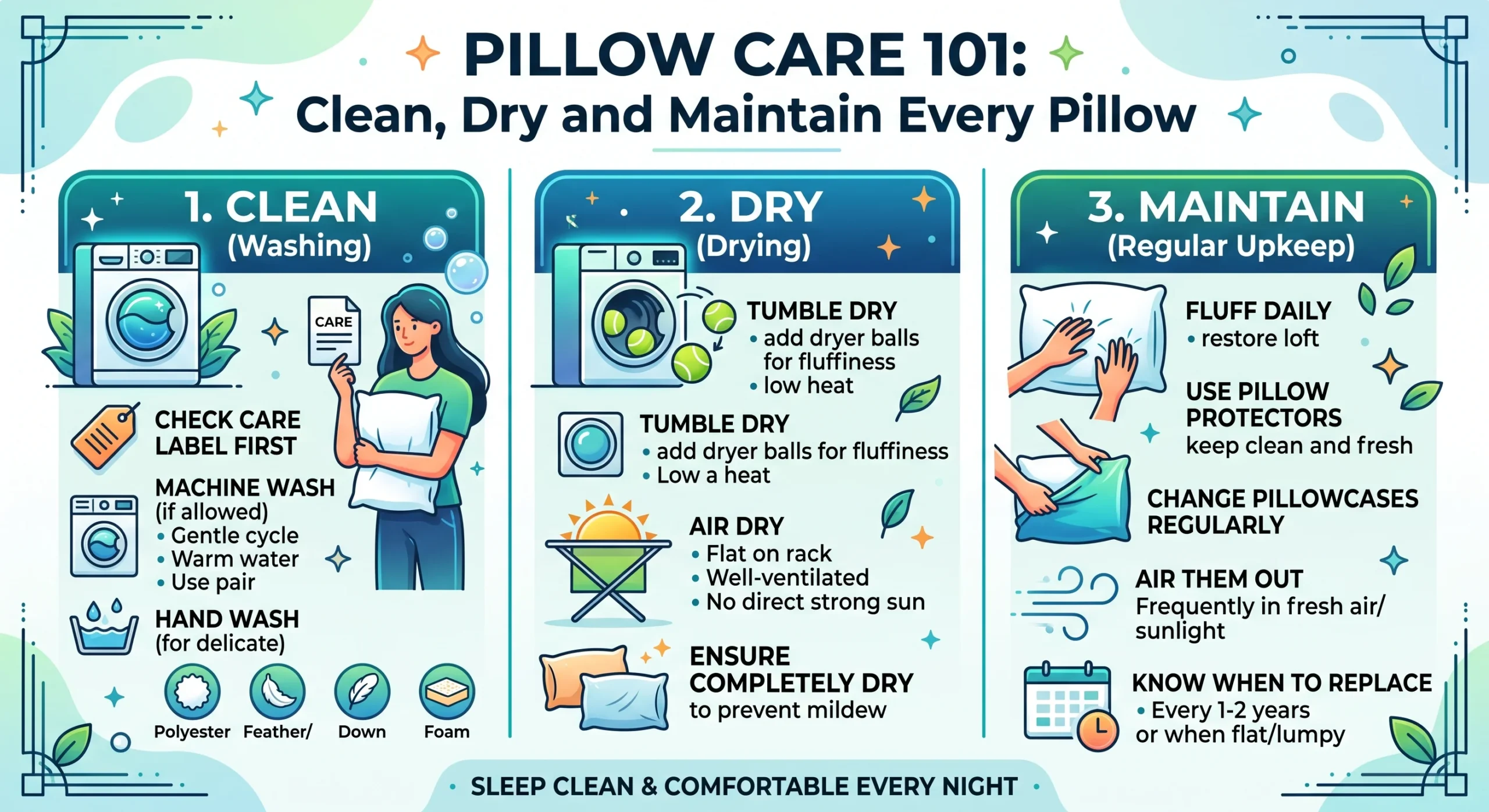
Pillow Care 101: Clean, Dry and Maintain Every Pillow
Pillow care comes down to four things: washing, drying, fluffing, and knowing when to stop and replace. Which of those you can actually do depends entirely on the fill. Most down, feather, cotton and polyester pillows can go in a washing machine. Memory foam and latex cannot, because the agitation breaks the foam apart. Buckwheat is different again, because the hulls have to stay dry. Find your fill type first, then follow the method that matches it. This page is the map. Each section below points to the full procedure.
Start here: what kind of pillow do you actually have?
Before any washing or drying advice is useful, you need to know what is actually inside your pillow. If you still have the care label, start there. If you do not, a quick physical check narrows it down fast: memory foam is a single dense block that slowly springs back when pressed; latex feels similar but slightly springier and often has visible venting holes; down and feather compress almost flat under a hand and rustle faintly; polyester and fiberfill feel uniformly soft and springy throughout; buckwheat pillows are heavy, shift audibly, and are firm rather than soft.
That identification decides everything that follows. A memory foam pillow and a down pillow are cared for in almost opposite ways, and treating one like the other is how pillows get ruined.
The pillow care matrix
Here is the whole system in one table. Use it as the index for this page and the cluster of guides it links to.
| Fill type | Machine washable | Drying method | Can it be fluffed | Typical lifespan |
|---|---|---|---|---|
| Down / feather | Usually yes | No-heat tumble dry with dryer balls | Yes | Roughly 2 to 4 years |
| Memory foam | No | Air-dry only, never a dryer | No (reshapes, does not fluff) | Roughly 3 to 5 years |
| Latex | No | Air-dry only | No | Roughly 2 to 4 years |
| Polyester / fiberfill | Usually yes | No-heat or low-heat tumble dry | Yes | Roughly 1 to 2 years |
| Buckwheat | No (hulls must stay dry) | Casing only, hulls sun-aired | Not in the usual sense | Hulls can last many years with care |
Treat the lifespan column as a general range, not a fixed rule. Sources genuinely disagree on exact numbers, and the honest answer is that fill quality, usage and climate all move it.
Washing: what is safe, what is not, and how often
The single most important question before you wash anything is whether the pillow can go in a machine at all. Down, feather, cotton and polyester pillows generally can. Memory foam and latex cannot, because a washing machine's agitation physically breaks the foam structure apart, and that damage does not reverse. Buckwheat pillows are a different case again: the hulls cannot get wet, so only the casing is washed, separately from the hulls.
If the pillow is machine washable, the short version is: wash two at a time so the load stays balanced, use a delicate or gentle cycle with cold water, and add an extra rinse. The full step-by-step, including what to do when there is no care label left to read, is in How to Wash Pillows in a Washing Machine. If a pillow does not fit a machine, or should not go in one, How to Hand-Wash a Pillow and the fuller bathtub method for full-size soaks cover the alternative.
Frequency is its own question, and the honest answer is a range rather than a single number: guidance runs from roughly every three months to every six months, and the sources disagree because they are answering slightly different questions. The full breakdown, including what pushes you toward the shorter end, is in How Often Should You Actually Wash Your Pillows?
Drying: the step that ruins more pillows than washing does
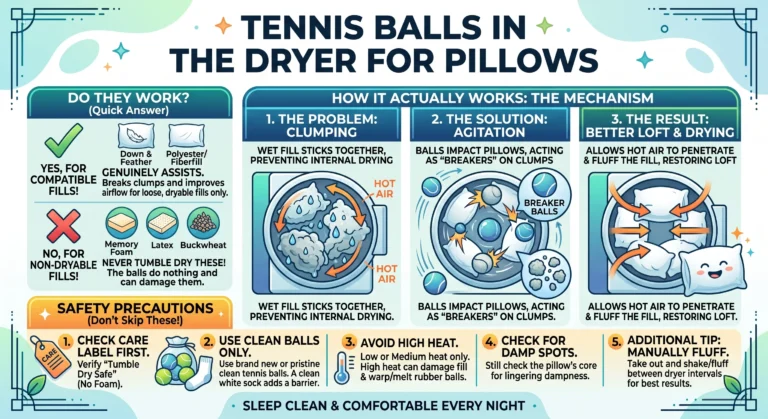
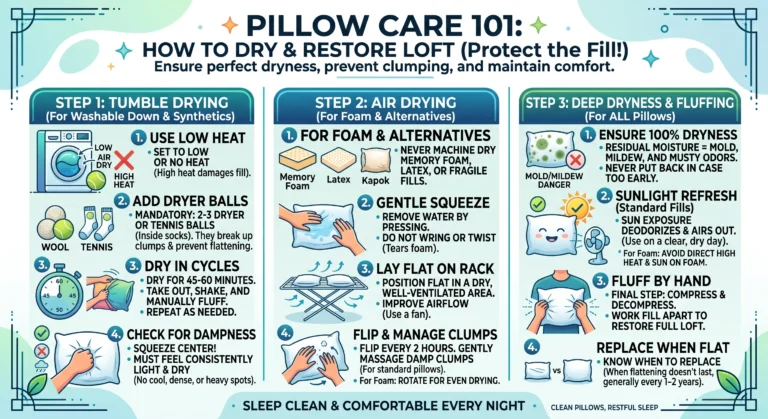
More pillows are ruined in the dryer, or by drying incorrectly, than in the wash itself. Heat is the main hazard: heated dryer cycles can alter or damage the fill, particularly synthetic and foam materials. A no-heat or air-dry setting, with dryer balls or clean tennis balls to break up clumping, is the safer default across most washable fill types.
The order that matters here, and the one thing most guides skip: dry before you judge. A pillow can look and smell wrong straight out of the wash purely because it is not fully dry at the core, even though the surface feels dry. People sometimes throw out a perfectly good pillow at exactly that moment. The dryness test, the realistic time it actually takes, and what to do without a dryer at all are covered in How to Dry Pillows Without Ruining the Fill.
Stains: yellowing, sweat and spot marks
Yellowing is the most common pillow complaint, and it is usually sweat and body oil that has soaked through over months or years, not a sign that something is wrong with you or your habits. It is often treatable, though older, deeply set yellowing tends to lighten rather than disappear completely. There is a real safety point here worth repeating on its own: never combine bleach with ammonia or vinegar, because that combination can produce toxic gas. The full ranked method list, including which to try first, is in How to Get Yellow Stains Out of Pillows, and a bleach-free version of that same goal is in How to Whiten Pillows Without Bleach.
Sweat, body-oil and localized spot marks each respond to slightly different treatment, and matching the method to the stain type matters more than reaching for the strongest product available. The gradual, all-over graying built up over months is covered in Sweat and Body-Oil Stains on Pillows; a single, fresh mark like makeup, drool or hair product is covered by type in Pillow Stain Removal.
Odors: getting a smell out, and the smell that appears after washing
Two different odor problems get confused constantly. A pillow that has simply picked up smell over time from ordinary use is one problem. A pillow that smells worse right after washing is a different, more specific problem, and it is almost always a drying failure rather than a washing failure: moisture trapped at the core, especially in feather fills, lets mildew or bacteria develop. If your pillow smells musty after a wash, the fix is in the drying guide above, not in re-washing it again.
Shape: fluffing, and the pillows that cannot be fluffed
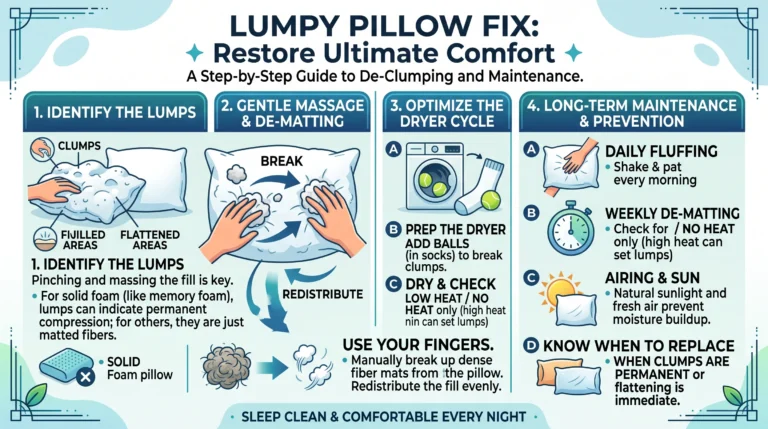
Fluffing works on down, feather, polyester and fiberfill pillows because the fill inside them is loose and can be redistributed by hand or by the tumbling action of a dryer. It does not work on memory foam or latex, because the fill in those pillows is a solid block rather than loose material; there is nothing to redistribute. If a foam or latex pillow has gone flat, the fix is not fluffing, it is a different conversation about whether the pillow is simply worn out.
Storage: keeping spare pillows from coming out musty
Pillows stored for guests or seasonally need to go into storage completely dry and ideally in a breathable container rather than a sealed plastic bag, which traps whatever residual moisture remains and encourages the same mildew problem described above. A pillow that comes out of storage smelling off was very likely stored slightly damp, not attacked by anything new.
When care is no longer the answer: the replace decision
Care extends a pillow's life, it does not make it permanent. A simple physical check many sources describe is the fold test: fold the pillow in half and see whether it springs back to shape on its own. A pillow that stays folded, or that has gone permanently lumpy or flat despite good care, has reached the end of what washing and fluffing can fix. That is a separate decision from anything on this page, and it is worth treating as its own question rather than a footnote.
FAQ
Can I wash any pillow in the washing machine?
No. Down, feather, cotton and polyester pillows generally can be. Memory foam and latex pillows cannot, because machine agitation breaks the foam apart. Buckwheat pillows should never have their hulls get wet.
How do I know what my pillow is filled with if the label is gone?
Feel and behavior are the best clues. Memory foam and latex are dense and slowly spring back. Down and feather compress almost flat and rustle. Polyester and fiberfill feel uniformly soft throughout. Buckwheat is heavy and shifts audibly.
Why does my pillow smell musty right after I wash it?
This is almost always incomplete drying rather than a washing problem. Moisture trapped at the core, especially in feather fills, allows mildew or bacteria to develop. Drying it thoroughly, including checking the center, usually resolves it.
Is there one correct schedule for washing pillows?
Not exactly. Guidance genuinely varies across sources, generally landing somewhere between every three and six months. Personal factors like sweating, pets on the bed and allergies push it toward the shorter end.
Can a flat pillow always be fixed by fluffing?
Only if the fill is loose material, like down, feather, polyester or fiberfill. A foam or latex pillow that has gone flat cannot be fluffed back into shape, because there is no loose fill to redistribute.