Lumpy Pillow Fix: What Works for Each Fill Type
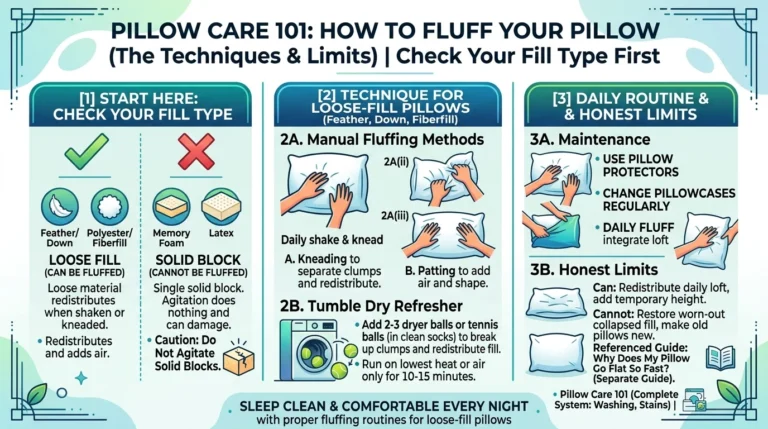
Whether a lumpy pillow can be fixed depends almost entirely on what's inside it. Loose fills like down, feather, shredded foam and buckwheat usually lump because the fill has shifted or clumped together, and working the clumps apart by hand (then drying the pillow all the way through if the lumps came from moisture) often brings it back. Polyester fiberfill that has matted into hard knots rarely separates properly again. A lump or dent in a solid foam or latex pillow isn't a clump at all; it's the material breaking down or tearing, and kneading won't fix it.
So the first job isn't fixing. It's finding out which kind of lump you have.
Step 1: Find out what the pillow is filled with
Everything below depends on the fill, so start with the label. The Federal Trade Commission lists pillows among the bedding products covered by its Textile Act labeling requirements (read September 11, 2026), so fiber content is normally stated on the label or packaging. The care instructions are usually on the same tag, and they overrule anything general you read, including here.
If the label is gone, feel is a decent guide. Down and feather compress almost flat under your hand and rustle. Fiberfill feels uniformly soft and springy when it's healthy. Shredded foam feels like small, irregular pieces you can move around. Buckwheat is heavy and sounds like sand when you shift it. Solid foam and latex feel like one piece.
What a lump usually means, by fill
| Fill | What a lump usually is | Fixable? | First move |
|---|---|---|---|
| Down or feather | Clusters stuck together, often from moisture | Often | Break apart by hand; dry fully if it's been damp |
| Polyester fiberfill | Fibers matted into knots | Sometimes, partly | Tease apart; a wash and full dry may help if the label allows |
| Shredded foam | Pieces migrated into corners or one end | Usually | Knead and redistribute; unzip if the pillow opens |
| Buckwheat | Hulls shifted to one side | Yes | Shake and push hulls back into place |
| Solid memory foam or latex | A dent, crack or tear in the core | No | Check the cover and core for damage |
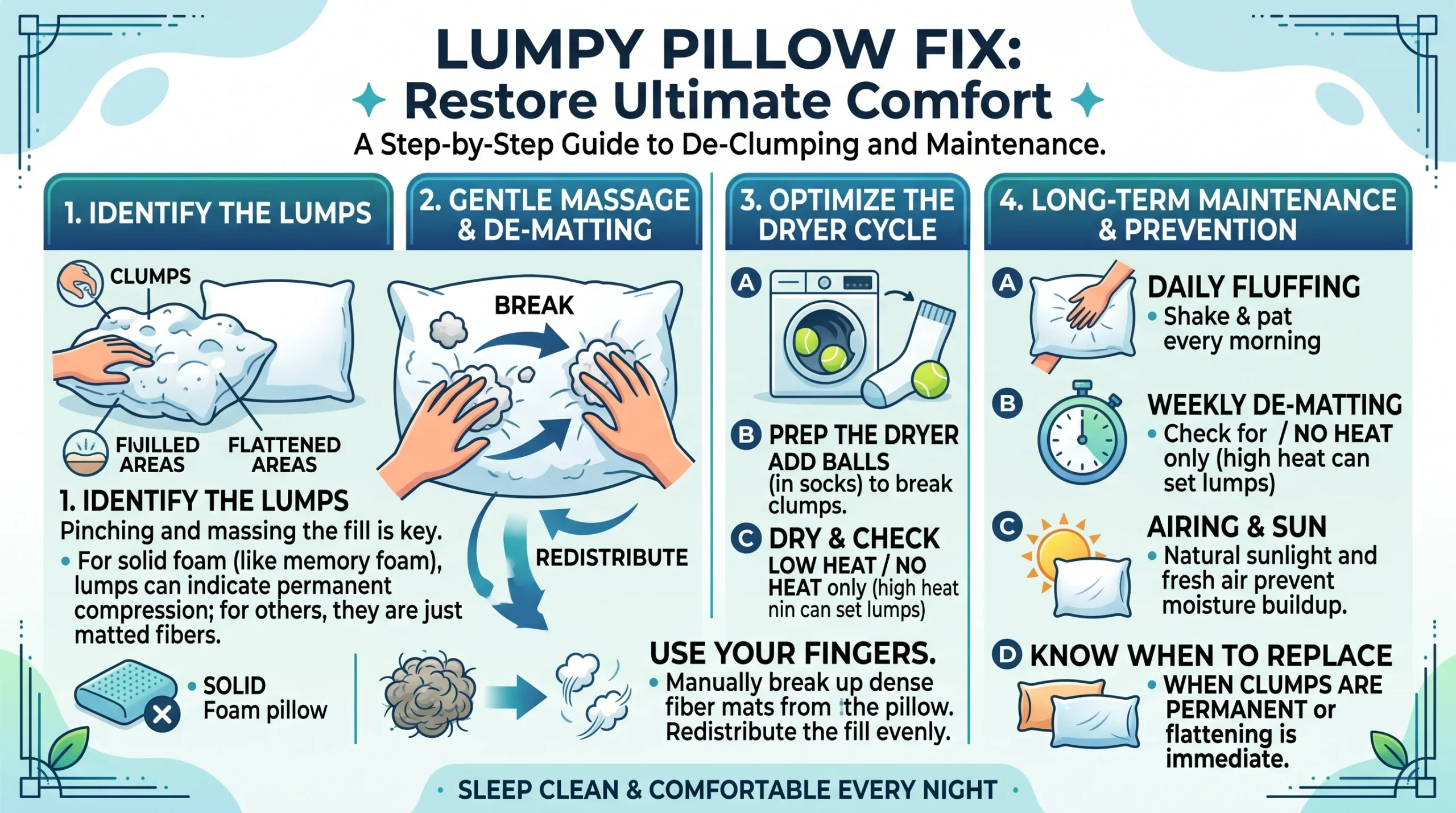
The lumpy pillow fix for loose fills: the hand method
This works for down, feather, shredded foam and, to a lesser degree, fiberfill. It takes a few minutes and needs nothing but your hands.
- Take off the pillowcase and protector so you can feel the fill directly.
- Find each lump by pressing across the pillow with flat hands. Note where the fill has gathered and where it has thinned.
- Work the lump from its edges inward. Pinch the edge of the clump through the fabric and gently pull it apart, a little at a time. Pulling from the middle tends to just move the whole clump.
- Push loosened fill toward the thin spots. Squeeze from both sides toward the empty area, like smoothing toothpaste back up a tube.
- Shake the pillow firmly by two corners, then the other two, so the fill settles evenly.
- Check again. If the lump re-forms within a night, the cause is probably moisture or matting rather than simple shifting, covered below.
For a zippered pillow with shredded foam, you can open it and redistribute the pieces directly, which is faster and more even than working through the fabric.
When lumps come from moisture: dry it all the way through
Down and feather are the fills most likely to clump because of moisture. A pillow that was washed and not fully dried, or one that absorbs sweat night after night, can form wet clusters in the core that feel like lumps. Kneading only helps briefly, because the clusters stick together again while they're damp.
The fix is getting the core completely dry, not just the surface. If your pillow's care label allows machine drying, dry it at the setting the label gives and keep going until the center is dry, pulling it out now and then to break up clumps by hand as it dries. A pillow that feels dry on the outside can still be damp inside. The full washing and drying process, including which fills should never go in a machine at all, is in how to wash pillows in a washing machine.
If you notice a musty smell along with the lumps, treat that seriously. A pillow that has stayed damp inside can develop mildew, and at that point the lumps are the smaller problem. That's a replace decision rather than a fix.
Fiberfill: why the knots often come back
Polyester fiberfill is springy when new because its fibers are loose and separate. With use, washing and compression, the fibers can tangle and mat into dense knots. You can tease a knot apart through the fabric, and a wash and full dry (if the label allows) sometimes loosens it further. But matted fiberfill tends to re-form knots quickly, and the pillow is often thinner overall once you've spread what's left. If the knots are back after a few nights, the fill has usually reached the end of its useful life.
Shredded foam and buckwheat: shifting, not failing
These two fills mostly lump because the pieces move. Shredded foam drifts into corners or one end, especially if you hug or fold the pillow. Buckwheat hulls pile up on the side you don't sleep on. Neither is a sign the pillow is failing. Knead or shake the fill back into place, and if the pillow opens, even it out from the inside.
If a shredded foam or buckwheat pillow still feels uneven after redistributing, it may simply have too little fill left. Many zippered designs let you add fill, and the maker's own instructions are the place to check what's compatible.
Solid foam and latex: when a lump isn't a lump
A solid foam or latex pillow can't clump, because there's nothing loose inside to gather. If you feel a ridge, a dent or a hard spot, check for three things: a crumpled inner cover, a crack or tear in the core, or a section that has permanently compressed. A crumpled inner cover can be smoothed out. A crack, tear or permanent dent can't be kneaded back, and washing or tumbling a foam or latex core to fix it can make things worse. Pillow Care 101 sets out what foam and latex will and won't tolerate.
When a lumpy pillow is done
Kneading and drying are worth trying first, but some lumps mean the pillow has reached the end:
- The lumps come back within a night or two, even after a full dry.
- Fiberfill has matted into knots that won't separate.
- There's a musty or mildew smell that survives a proper wash.
- A foam or latex core is cracked, torn or permanently dented.
- There isn't enough fill left to spread evenly, and the pillow can't be topped up.
The Asthma and Allergy Foundation of America, in its dust mite allergy guidance (read September 11, 2026), suggests replacing pillows every 2 years. That advice is framed around dust mites rather than lumps, but it's a useful outside reference if you've been nursing an old, lumpy pillow along for years.
What stops lumps coming back
Most lumps trace back to three habits: drying a pillow only partway, never redistributing loose fill, and letting sweat build up in the core. Drying all the way through after every wash, shaking loose-fill pillows out when you make the bed, and using a protector between washes all help. None of them will rescue fill that has already matted, but they slow down how quickly a good pillow gets there.
FAQ
Why is my pillow lumpy after washing?
Usually because the fill, most often down or fiberfill, clumped while wet and wasn't fully dried. The surface can feel dry while the core is still damp. Break the clumps apart by hand and dry it again, following the care label, until the center is dry.
Can I fix a lumpy pillow without a dryer?
For shifted fill, yes: the hand method above needs no machine. For moisture clumps, the pillow still has to dry completely. Air drying works for many fills but takes much longer, and you'll need to turn it and break up clumps as it goes.
Can I add new fill to a lumpy pillow?
If the pillow has a zipper and the maker sells or specifies compatible fill, often yes. A sewn-shut pillow is a different matter; opening the seam is possible but it's a sewing project, and the result depends on matching the fill.
Is a lumpy pillow bad for my neck?
A lumpy pillow supports your head unevenly, which some people find uncomfortable. Whether it's behind any neck pain you have is a question for a doctor or physical therapist. MedlinePlus, from the National Library of Medicine, lists signs that warrant contacting a provider for neck pain (read September 11, 2026), such as pain that hasn't gone away after a week of self-care, or numbness or tingling in your arm or hand.
Most lumps in loose-fill pillows are fixable in a few minutes. The ones that come back, smell musty, or live in a solid core are the pillow telling you it's finished.