Why Is My Pillow So Hot? The Four Causes to Check
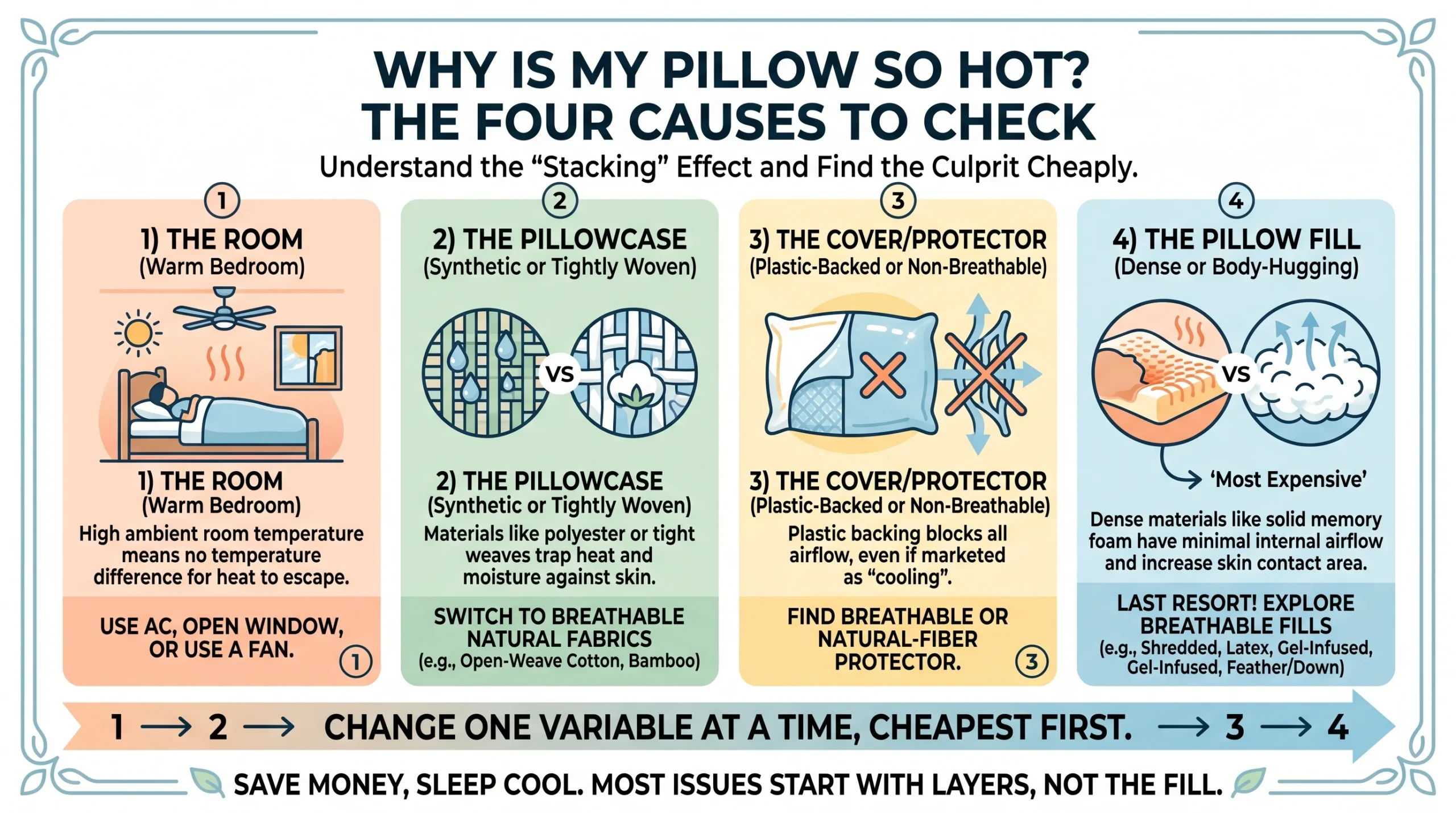
A pillow gets hot because the heat and moisture coming off your head have nowhere to go. Four layers decide how easily they escape: the room, the pillowcase, the pillow’s own cover or protector, and the fill. A warm bedroom, a tightly woven synthetic case, a plastic-backed protector and a dense, body-hugging fill each hold heat against your skin, and their effects stack. Change one variable at a time, cheapest first, and you can usually find the culprit before you spend anything.
That order matters. Most of what you’ll read on this question comes from companies selling cooling pillows, so the advice jumps straight to the fill. The fill is often part of the story, but it is the most expensive thing to change, and sometimes it isn’t the main cause at all.
How a pillow gets hot in the first place
Your head and neck give off warmth and a little moisture all night. A pillow feels cool when you first lie down because it starts at room temperature, and then it warms up until it roughly matches you. Whether it stays uncomfortably warm after that depends on how easily heat and moisture can move away from your skin: into air pockets in the fill, through the fabric layers, and out into the room.
Anything that slows that movement makes the pillow feel hot. That’s why the honest answer to “why is my pillow so hot” is usually several small things rather than one faulty pillow, and why swapping only the pillow sometimes changes very little.
The four variables, from cheapest to test to most expensive
| Layer | What tends to trap heat | First thing to try | Cost to test |
|---|---|---|---|
| The room | Warm, still air; sun on the bed; a pillow pushed against a warm wall or vent | Cool the room, add airflow, move the bed or pillow | Usually free |
| The pillowcase | Tightly woven or synthetic fabrics that breathe less | Swap to a different case you already own | Usually free |
| The cover or protector | A waterproof, plastic-backed protector; a dense synthetic zip cover | Sleep a night or two without the protector | Free |
| The fill | Solid foam that molds around your head; tightly packed or compressed fill | Adjust the fill if you can; try another pillow in the house | Varies |
Work down the table in order and give each change a couple of nights. If you change everything at once and the problem goes away, you won’t know which change did it, and you may end up replacing a pillow that was fine.
Step 1: Rule out the room
Start here because it costs nothing and it affects every other layer. The National Heart, Lung, and Blood Institute, part of the NIH, advises keeping your bedroom “quiet, cool, and dark” in its guidance on healthy sleep habits (read September 11, 2026). It doesn’t give a single target temperature, and neither will we.
What to look for is practical. Is the bed under a window that gets afternoon sun? Is the head of the bed against a wall that backs onto a warm room, or near a heating vent? Is the air still? A pillow can only shed heat into the air around it, and if that air is already warm and not moving, even a breathable pillow will feel hot. Try a night with the room cooler or a fan moving air across the bed. If the pillow still heats up quickly in a cool room, the cause is closer to your head.
Step 2: Check the pillowcase
The pillowcase is the layer your skin actually touches, so it has an outsized effect for something so cheap. Fabrics differ in how readily they let air and moisture pass. Many people find tightly woven synthetic fabrics feel warmer than looser natural-fiber weaves, though the weave and the thickness matter as much as the fiber.
Before assuming anything, read the label. The Federal Trade Commission lists pillows and pillowcases among the bedding products covered by its Textile Act labeling requirements (read September 11, 2026), so the fiber content is normally stated on the label or packaging. Keep in mind that “satin” describes a weave, not a fiber: a satin case can be silk or polyester, and the label is how you tell.
The test is simple: swap the case for a different fabric you already own and compare a few nights.
Step 3: Take off the protector for a night
This is the layer people forget, because it’s hidden under the pillowcase. Waterproof protectors usually have a laminated or coated backing, which is what stops liquid getting through. The same backing can also slow moisture and warmth moving away from your head.
Sleep a night or two with the protector off and see whether it changes. If it does, you’ve found a big part of the answer, but think before removing it for good. A protector also shields the fill from sweat and oil between washes, and some people use a zippered allergen cover for dust mites. Losing the heat can mean washing the pillow itself more often. Pillow Care 101 covers how each fill should be cleaned and dried, which matters if the protector comes off.
Step 4: Look at the fill last
Only once the room, case and protector are ruled out does the fill deserve the blame. Here is how common fills tend to behave, stated as tendencies rather than rules, because design differs a lot from one maker to the next:
- Solid memory foam: molds closely around your head and neck, which leaves little air moving around you. It is the fill most often described as sleeping warm.
- Shredded foam: the pieces leave gaps between them, so there is usually more room for air than in a solid block.
- Latex: some latex pillows are made with ventilation holes and some aren’t; the maker’s description tells you which yours is.
- Down and feather: loose clusters that can be shaped, though an overstuffed or clumped pillow holds less air.
- Polyester fiberfill: fine when lofty, but once it compresses into a dense pad it traps more heat against you.
- Buckwheat: the hulls leave air gaps between them and don’t mold tightly around your head, which is why people who run warm often consider it.
CertiPUR-US, the foam certification program, says in its guide to choosing a pillow (read September 11, 2026) that “hot sleepers benefit from breathable, cooling and moisture-wicking properties.” That is a sensible description of what to look for, not a guarantee from any specific product.
One more fill-related cause is easy to miss: age and buildup. Over months, sweat and body oil work into a pillow and help pack the fill down, which leaves less air in it. If your pillow’s care label allows machine washing, washing it and drying it all the way through can loosen fill that has packed down. The steps are in how to wash pillows in a washing machine, including which fills should never go in.
Why is my pillow so hot even though it’s a cooling pillow?
This is a common complaint, and there are two usual reasons.
The first is how “cool to the touch” works. A surface that feels cool on contact is drawing heat away from your skin. Once it has absorbed what it can and warmed toward your temperature, that sensation fades. That’s why the feel in the first minute, in a store or straight out of the box, is a weak test of how a pillow behaves at 3 a.m.
The second is that the other three layers still apply. A cooling cover under a heavy synthetic pillowcase, over a plastic-backed protector, in a warm room, has very little chance to do its job. Before writing off a cooling pillow, run Steps 1 to 3 with it.
What the labels on the package can and can’t tell you
Pillow packaging often carries certification marks next to a cooling claim, and it’s easy to read them as backing each other up. They don’t.
- OEKO-TEX STANDARD 100: OEKO-TEX says every item bearing the label “is certified as having passed safety tests for the presence of harmful substances,” tested against a list of more than 1,000 of them (OEKO-TEX, read September 11, 2026). It is about substances, not temperature.
- GOTS: the Global Organic Textile Standard describes itself as a sustainability standard for processing certified organic fibers, covering environmental, social and human rights criteria (GOTS, read September 11, 2026). Also not a temperature rating.
- CertiPUR-US: the program says certified foams are made without formaldehyde, ozone depleters, regulated phthalates and certain heavy metals, and have low VOC emissions, less than 0.5 parts per million (CertiPUR-US, read September 11, 2026). Again, nothing about heat.
None of these is a temperature rating, so a cooling claim printed alongside them is the maker’s own description, not something the certification speaks to. Judge that claim by the materials and construction, and by the four-layer test above.
When the heat probably isn’t about the pillow
If the room is cool, the bedding is light, you’ve worked through all four layers and you still wake up soaked, the pillow is unlikely to be the whole story. That pattern is worth mentioning to a doctor rather than trying to solve with another pillow.
FAQ
Does flipping the pillow help?
For a few minutes. The other side has been sitting at room temperature, so it feels cooler, but it warms up the same way. Flipping is a comfort trick, not a fix; if you’re flipping every night, one of the four layers is holding heat.
Is memory foam always hot?
Not always. Solid memory foam is the fill most often described as sleeping warm, but shredded foam, ventilated designs and the covers around the foam all change how it behaves. The fill is one variable of four.
Does a silk or satin pillowcase keep a pillow cooler?
It depends on what the case is actually made of. Satin is a weave, not a fiber, so a satin case can be polyester or silk. Check the fiber on the label and compare it against a case you already own for a few nights.
How do I find out what my pillow is filled with?
Check the label first; pillows are among the bedding items the FTC’s textile labeling rules cover. If the label is gone, feel is the next clue: foam and latex are dense and spring back slowly or evenly, down compresses and rustles, fiberfill feels uniformly soft, and buckwheat is heavy and shifts audibly.
A hot pillow is usually a stack of small causes. Test the room, the case and the protector before you judge the fill, and you’ll either fix it for free or know exactly what to look for next time.