Pillow Too Flat? What Actually Adds Loft
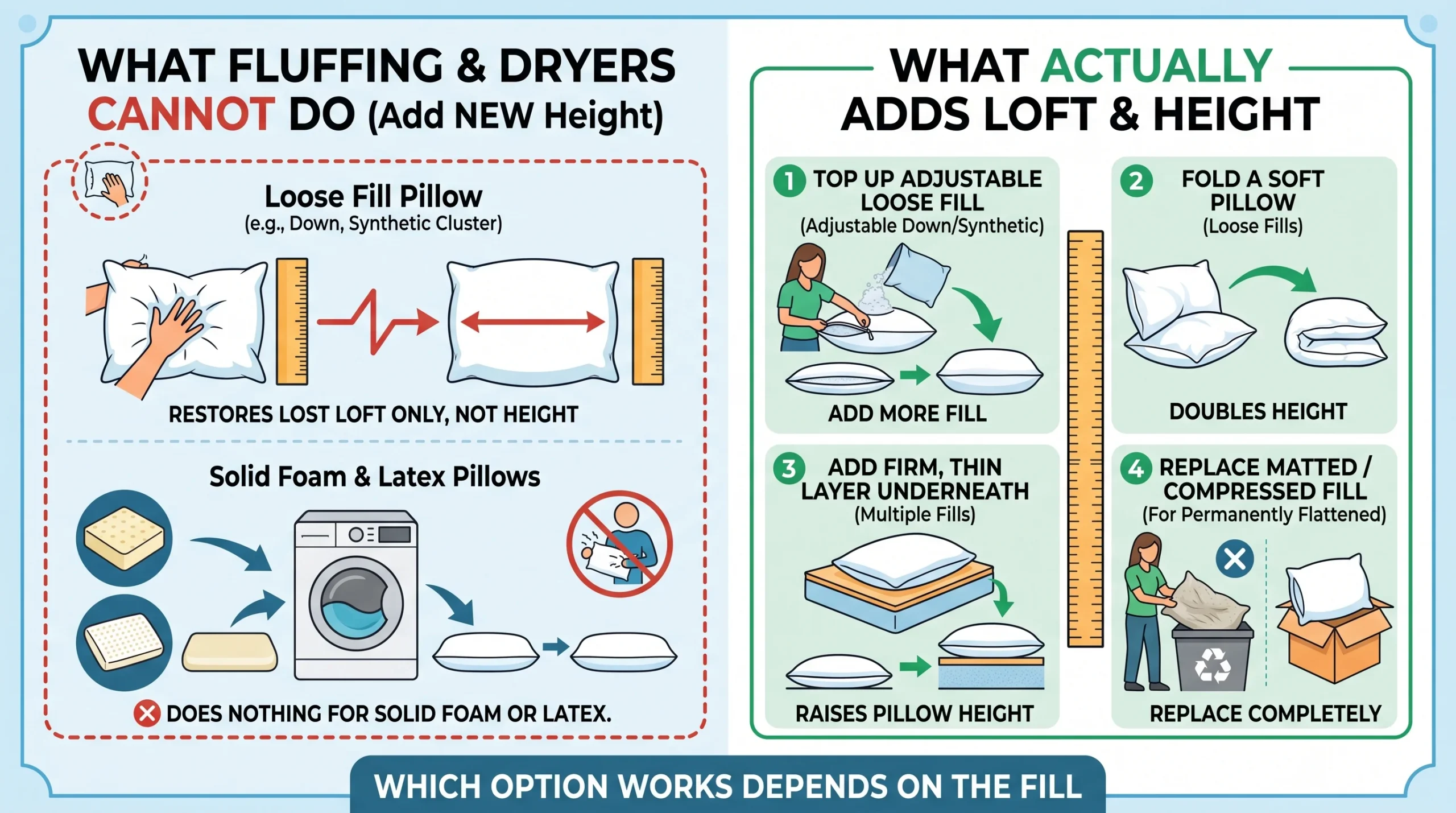
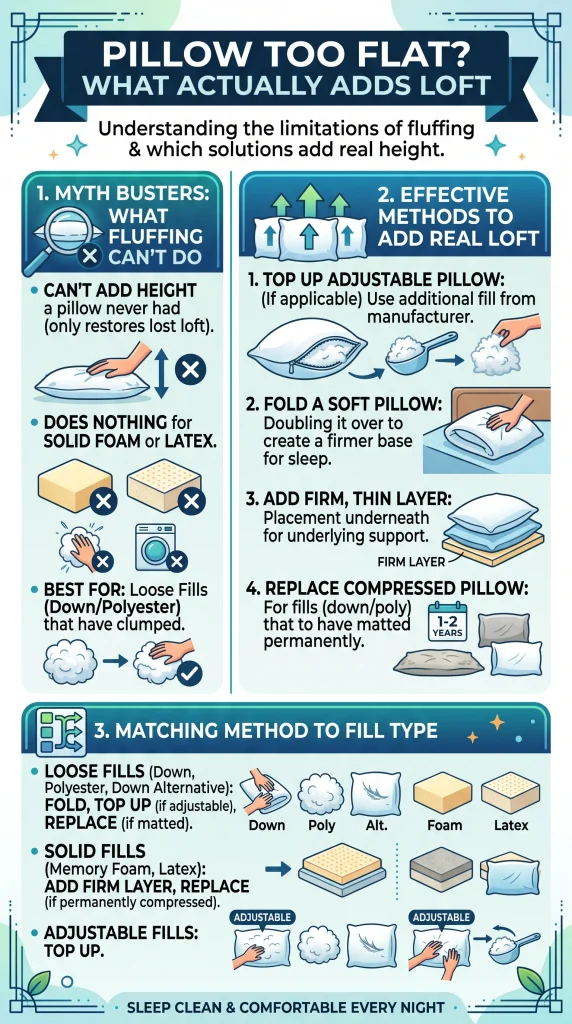
Fluffing and a trip through the dryer can only bring back loft that a loose fill has lost. They can’t add height a pillow never had, and they do nothing for solid foam or latex. If your pillow is too flat, the options that actually add loft are: topping up an adjustable pillow with more fill, folding a soft pillow to double it, adding a firm, thin layer underneath, or, for fills that have matted or compressed for good, replacing it. Which one works depends on what the pillow is filled with.
First, figure out which of two different problems you have.
Is it flat, or just too low for you?
“Too flat” covers two situations that need different fixes.
It used to be higher and has gone flat. The fill has compressed, clumped or broken down with use. For loose fills, some of that height can come back with fluffing and proper drying. For fills that have matted or permanently compressed, it can’t.
It was never high enough for you. The pillow is in good condition, it just doesn’t have the loft your sleep position or body needs. No amount of fluffing fixes this, because there’s no lost air to put back. You need more material under your head.
A simple check: fold the pillow in half and let go. A loose-fill pillow in decent condition should spring back open, at least partly. One that stays folded, or unfolds slowly and limply, has lost much of its structure. If it springs back but still feels too low when you lie on it, it’s the second problem.
How much loft you need depends on how you sleep
There’s no universal right height. CertiPUR-US, the foam certification program, sums up the usual pattern in its guide to choosing a pillow (read September 11, 2026): side sleepers “need a higher loft that relieves pressure on the shoulder,” back sleepers should look for “a medium-loft pillow that supports their neck without forcing their head upwards or pressing it flat against the mattress,” and stomach sleepers “should look for compressible materials that allow a low loft.”
So a pillow that’s perfectly fine for a stomach sleeper can be too flat for a side sleeper. Your mattress plays a part too. On your side, a firm mattress keeps your shoulder higher, which widens the gap your pillow has to fill. If you’ve moved to a firmer bed, a pillow that used to be right can suddenly feel flat.
What actually adds loft, by fill
| Fill or design | Best way to add loft | Notes |
|---|---|---|
| Adjustable shredded foam or fiber (zippered) | Add more of the maker’s compatible fill | The cleanest fix; add a little at a time |
| Buckwheat (zippered) | Top up with more hulls | Buckwheat pillows are commonly topped up rather than replaced |
| Layered foam with inserts | Add back an insert if one was removed | Check what came with the pillow |
| Down or feather | Fluff and dry fully; fold to double | Fluffing only restores lost loft |
| Polyester fiberfill | Fluff and dry if the label allows; fold | Matted fiberfill rarely recovers |
| Solid memory foam or latex | Add a thin, firm layer underneath | The core’s height is fixed |
Top up an adjustable pillow
If your pillow has a zipper and loose fill, adding fill is the most reliable way to raise it. Use fill the maker sells or specifies for that pillow, since mixing in something different changes how it feels and how it should be washed. Add a small amount, shake it through, and sleep on it before adding more. You can always add more; taking it back out is messier.
Fold a soft pillow
For down, feather and fiberfill, folding the pillow in half doubles the height under your head. It’s a quick way to test whether more loft actually helps before you spend anything. The trade-offs: a folded pillow is narrower, it can unfold during the night, and it isn’t very stable if you move a lot.
Add a thin, firm layer underneath
For solid foam and latex, which can’t be fluffed or topped up, the practical option is to raise the whole pillow. A folded towel or a thin, flat pillow placed underneath adds height without changing the feel of the surface your head touches. It’s also easy to adjust: add or remove a fold until it’s right. The downside is that the layers can slide apart, so it suits people who don’t move much in the night.
This isn’t the same as stacking two full pillows. Two full pillows usually add more height than you want and create a soft, wobbly stack. A thin layer gives you a small, controlled change.
Restore lost loft in loose fills
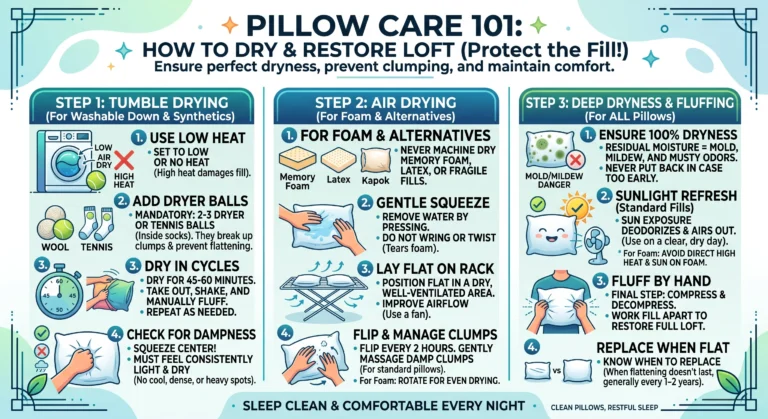
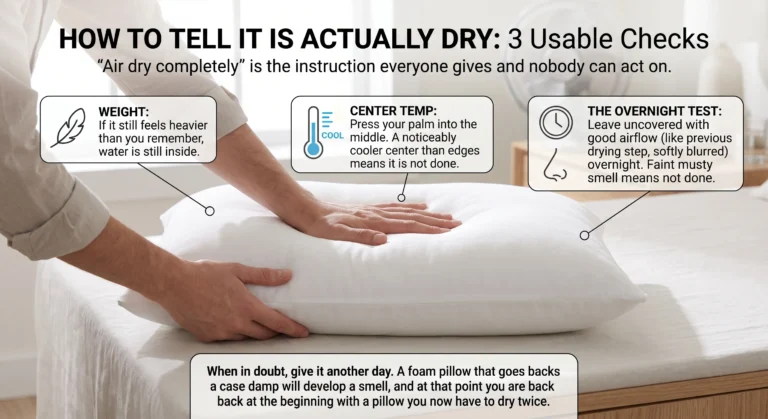
If your down, feather or fiberfill pillow has gone flat with use, fluffing it and drying it properly can bring some of that height back, because the fill has clumped or packed down rather than disappeared. The key is drying all the way through: a pillow that’s still damp in the core stays flat and clumpy. If the care label allows machine washing and drying, the process is in how to wash pillows in a washing machine.
What doesn’t add loft
- Fluffing foam or latex. Their height comes from a solid core, not from air trapped between fibers. Punching or tumbling them doesn’t raise them and can damage the core. Pillow Care 101 covers what foam and latex will and won’t tolerate.
- Fluffing a pillow that was never high enough. If the fill isn’t compressed, there’s nothing to restore.
- Stuffing extra material into a sewn-shut pillow through a gap. Loose additions shift into lumps and are hard to keep even.
- Putting a flat foam pillow in the dryer. Heat can damage foam and latex, and it doesn’t add height.
When a pillow that’s too flat can’t be saved
Some flat pillows are finished rather than fixable:
- Fiberfill that has matted into dense knots and stays flat after fluffing and a full dry.
- A foam core that has permanently compressed where your head rests.
- A pillow that stays folded when you fold it in half and let go.
- Flatness that comes with a musty smell that survives washing.
The Asthma and Allergy Foundation of America suggests replacing pillows every 2 years in its dust mite allergy guidance (read September 11, 2026). That’s framed around dust mites rather than loft, but if a flat pillow is also well past that age, it’s one more reason to stop trying to revive it.
A note if your neck or shoulder hurts
Adding loft is a comfort adjustment. It isn’t a treatment, and it can’t tell you why something hurts. MedlinePlus, from the National Library of Medicine, lists signs that warrant contacting a provider about neck pain (read September 11, 2026), including symptoms that haven’t improved after 1 week of self-care and numbness, tingling or weakness in your arm or hand. If any of those apply, see a doctor or physical therapist before experimenting with pillow height.
FAQ
Does putting a flat pillow in the dryer add loft?
It can restore some loft to down, feather and fiberfill if the flatness comes from clumping or moisture, as long as the care label allows machine drying. It won’t add height a pillow never had, and it isn’t suitable for foam or latex.
Is it better to use two pillows or one thicker one?
Two full pillows usually add more height than you need and tend to shift apart. If one pillow is a little too flat, a thin layer underneath or a top-up of fill gives you a smaller, more controllable change.
Can I add fill to any pillow?
Only easily to pillows with a zipper. Adjustable pillows are designed for it, and the maker’s own fill is the best match. A sewn-shut pillow would need the seam opened and resewn.
Why did my pillow go flat so fast?
Usually a mix of fill type, nightly compression, and moisture and body oil working into the fill. Loose fills like polyester flatten faster than others. If a pillow flattened right after a wash, incomplete drying is a common cause.
If a pillow has gone flat, try restoring it. If it was always too flat for you, stop fluffing and add real material, whether that’s more fill, a fold or a thin layer underneath.