How to Clean a Memory Foam Pillow Without Destroying It
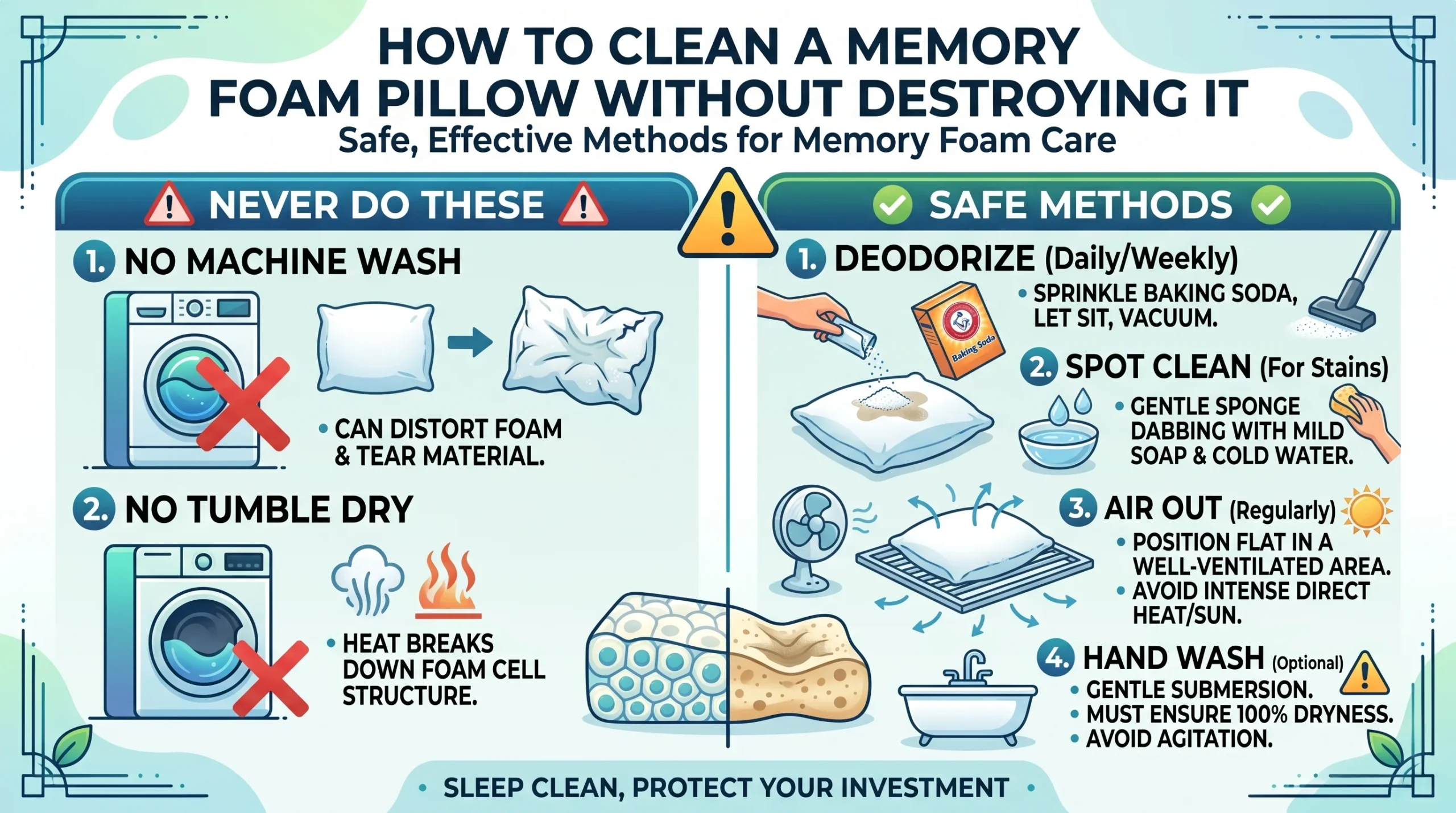
Do not put a memory foam pillow in a washing machine or a dryer. Agitation breaks down the foam’s cell structure and heat deforms it, and neither is reversible. Instead, work up in stages: vacuum the surface and use a dry baking soda treatment for general freshening, spot clean marks with a barely damp cloth and a little mild detergent, and only hand wash the whole pillow in lukewarm water when it genuinely needs it. Squeeze, never wring. Press the water out between towels and air dry it completely before it goes anywhere near a pillowcase.
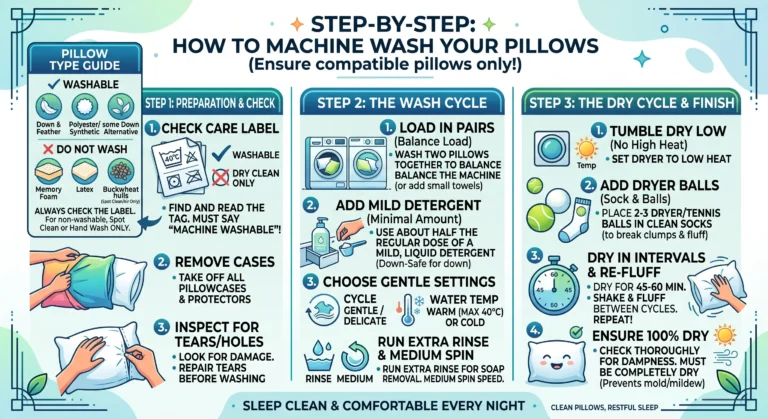
If you are not sure what fill you have, How to Wash Pillows in a Washing Machine covers the go/no-go decision by material. This page assumes you already know it is memory foam.
The rule that matters, and why it exists
Memory foam is a structured material, not a loose fill. It is a network of connected cells, and its ability to compress under your head and recover afterward depends on that network staying intact.
A washing machine attacks it in two ways at once. The agitation tears the cell walls mechanically, and once torn they do not knit back together. The spin cycle then compresses a waterlogged, weakened block of foam against the drum wall with a great deal of force. What comes out is either visibly crumbled or, more often, subtly ruined: it looks fine and it no longer supports anything.
A dryer attacks it with heat, which softens and deforms the foam permanently. A memory foam pillow that has been through a hot dryer often comes out slightly the wrong shape and stays that way.
Both failures are permanent. This is why the rest of this page is about doing less to the pillow, not more.
Check the manufacturer’s care instructions if you still have them. They are written for your specific pillow and take precedence over any general guidance, including this page.
Which of the three methods do you actually need?
Most memory foam pillows that get washed did not need washing. Match the method to the problem.
| What is wrong | Method | Does the pillow get wet? |
|---|---|---|
| Nothing specific, it just feels stale or dusty | Dry refresh: baking soda and a vacuum | No |
| A visible mark or a small spill | Spot clean | Only that spot |
| A smell, with no visible dirt | Dry refresh first, then see the odor page | No |
| A large spill, or genuine all-over grime | Hand wash | Yes, fully |
Work down this table, not up. Every step that keeps the foam dry is a step that carries no risk of damage.
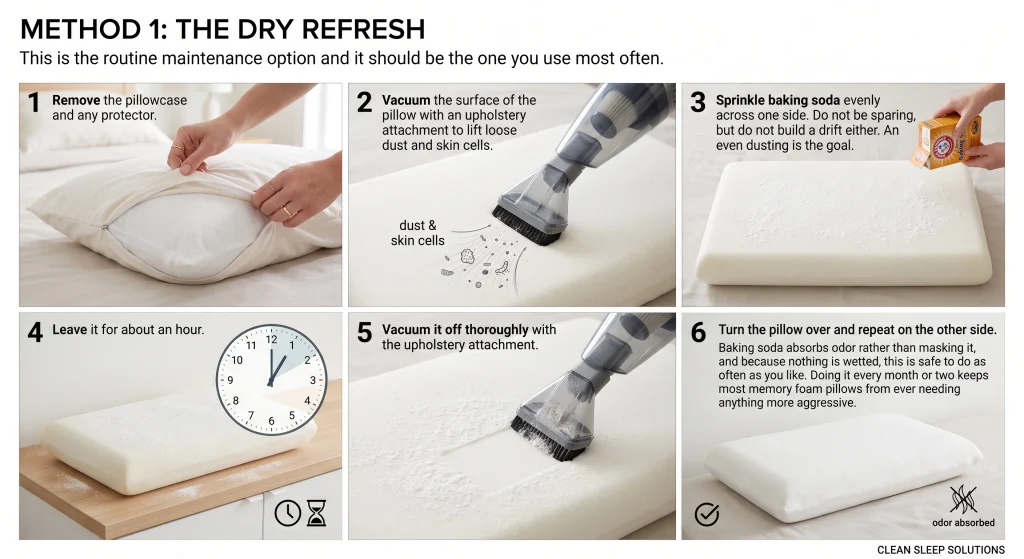
Method 1: the dry refresh
This is the routine maintenance option and it should be the one you use most often.
- Remove the pillowcase and any protector.
- Vacuum the surface of the pillow with an upholstery attachment to lift loose dust and skin cells.
- Sprinkle baking soda evenly across one side. Do not be sparing, but do not build a drift either. An even dusting is the goal.
- Leave it for about an hour.
- Vacuum it off thoroughly with the upholstery attachment.
- Turn the pillow over and repeat on the other side.
Baking soda absorbs odor rather than masking it, and because nothing is wetted, this is safe to do as often as you like. Doing it every month or two keeps most memory foam pillows from ever needing anything more aggressive.
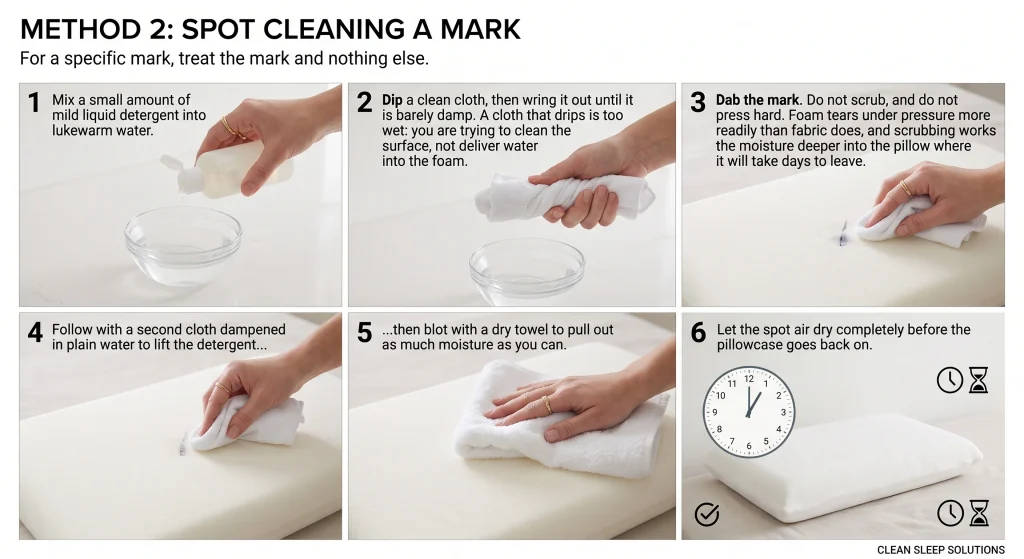
Method 2: spot cleaning a mark
For a specific mark, treat the mark and nothing else.
Mix a small amount of mild liquid detergent into lukewarm water. Dip a clean cloth, then wring it out until it is barely damp. A cloth that drips is too wet: you are trying to clean the surface, not deliver water into the foam.
Dab the mark. Do not scrub, and do not press hard. Foam tears under pressure more readily than fabric does, and scrubbing works the moisture deeper into the pillow where it will take days to leave.
Follow with a second cloth dampened in plain water to lift the detergent, then blot with a dry towel to pull out as much moisture as you can. Let the spot air dry completely before the pillowcase goes back on.
Method 3: hand washing the whole pillow
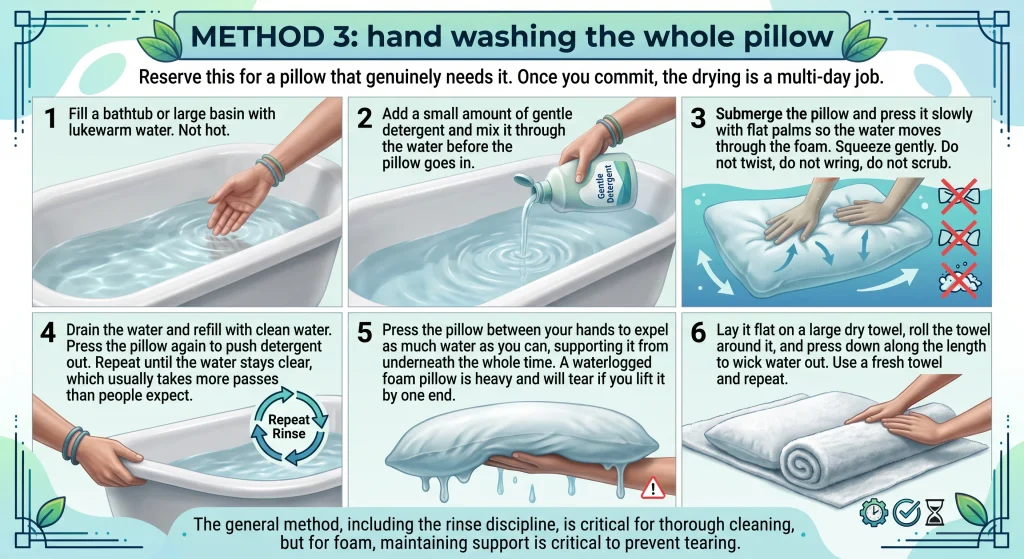
Reserve this for a pillow that genuinely needs it. Once you commit, the drying is a multi-day job.
- Fill a bathtub or large basin with lukewarm water. Not hot.
- Add a small amount of gentle detergent and mix it through the water before the pillow goes in.
- Submerge the pillow and press it slowly with flat palms so the water moves through the foam. Squeeze gently. Do not twist, do not wring, do not scrub.
- Drain the water and refill with clean water. Press the pillow again to push detergent out. Repeat until the water stays clear, which usually takes more passes than people expect.
- Press the pillow between your hands to expel as much water as you can, supporting it from underneath the whole time. A waterlogged foam pillow is heavy and will tear if you lift it by one end.
- Lay it flat on a large dry towel, roll the towel around it, and press down along the length to wick water out. Use a fresh towel and repeat.
The general method, including the rinse discipline, is covered in more depth in Hand-Washing and Spot-Cleaning Pillows That Cannot Go in a Machine, which applies to several fills.
Drying memory foam properly
This is the step people rush, and it is the step that produces the musty pillow.
Foam is effectively a closed sponge. Water sits in the middle of it long after every surface you can touch feels dry. There is no spin cycle to help, so a hand-washed foam pillow starts far wetter than a machine-washed fiberfill one.
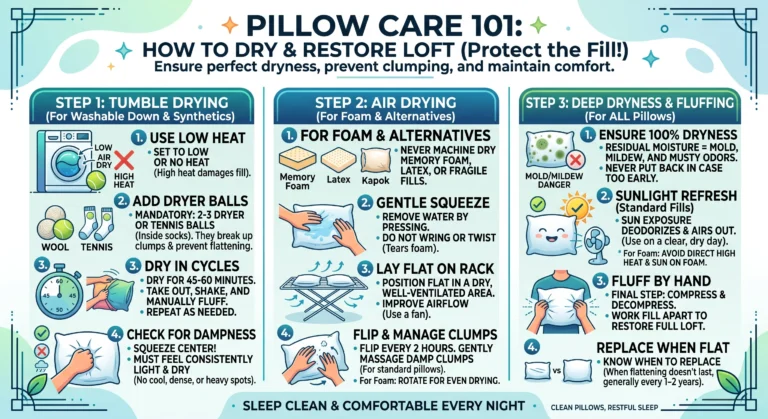
Lay the pillow flat in a well-ventilated room, ideally on a drying rack so air can reach it from underneath. If you only have a flat surface, put a dry towel under it and change that towel when it becomes damp. Turn the pillow every few hours. A fan pointed at it helps considerably and costs nothing.
Do not use a dryer. Do not use a hairdryer, a radiator or a heat vent. Heat is what deforms foam, and applying it to speed up drying trades a temporary problem for a permanent one.
Direct sun for a short period is a reasonable way to finish a pillow that is nearly dry, but prolonged sun exposure is not good for foam either. Ventilation and time are what actually work.
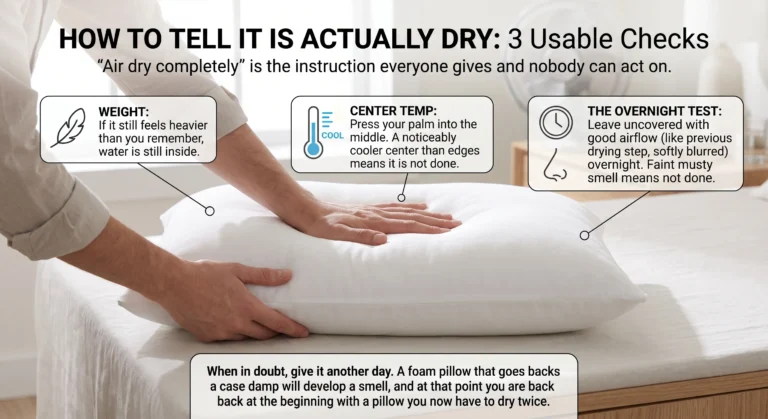
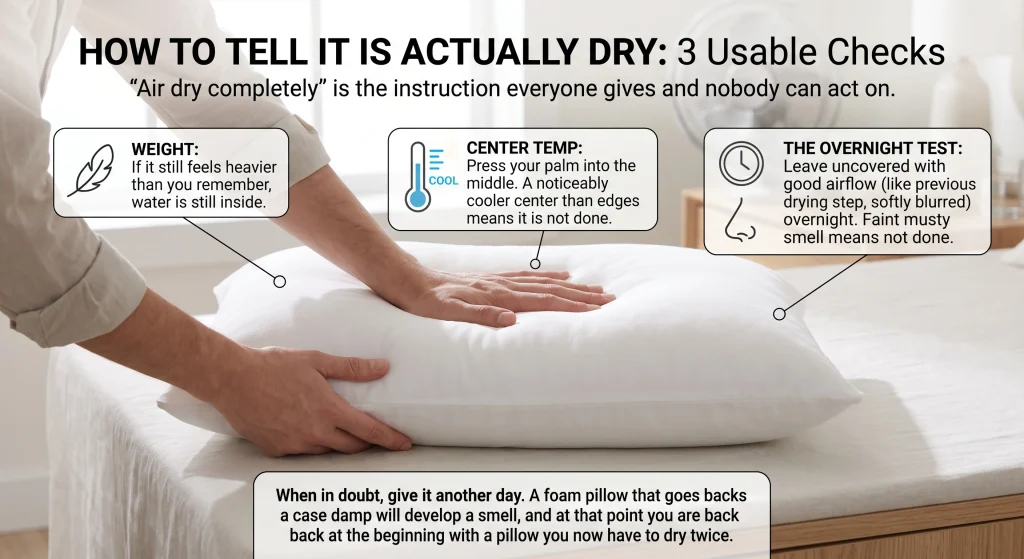
How to tell it is actually dry
“Air dry completely” is the instruction everyone gives and nobody can act on. Here are three checks that are usable.
Weight. A dry memory foam pillow is surprisingly light. If it still feels heavier than you remember, there is water in it.
Center temperature. Press your palm firmly into the middle of the pillow and hold it there. Evaporating moisture makes the center feel cooler than the edges. If the middle is noticeably cool, it is not done.
The overnight test. Leave the pillow uncovered somewhere with good airflow overnight after you think it is finished. If it smells faintly musty in the morning, it was not dry.
When in doubt, give it another day. A foam pillow that goes back into a case damp will develop a smell, and at that point you are back at the beginning with a pillow you now have to dry twice.
What ruins a memory foam pillow
| Mistake | What it actually does |
|---|---|
| Washing machine | Tears the foam cell structure, permanently |
| Dryer or any direct heat | Deforms the foam, permanently |
| Wringing or twisting | Tears wet foam, which is much weaker than dry foam |
| Scrubbing a stain | Damages the surface and drives moisture deeper |
| Too much detergent | Leaves residue that stiffens the foam and holds smells |
| Putting it back damp | Produces a musty smell and undoes the whole job |
When cleaning is not the answer
If the pillow has lost its shape, no longer springs back when you press it, or has crumbled anywhere, cleaning will not help. Memory foam degrades with use, and a pillow at that stage is finished regardless of how clean it is.
If the problem is only a smell and the foam is otherwise intact, start with the dry refresh above and then see How to Get Smells Out of a Pillow, which sorts odors by type. Wetting a foam pillow to solve a smell is usually the wrong move.
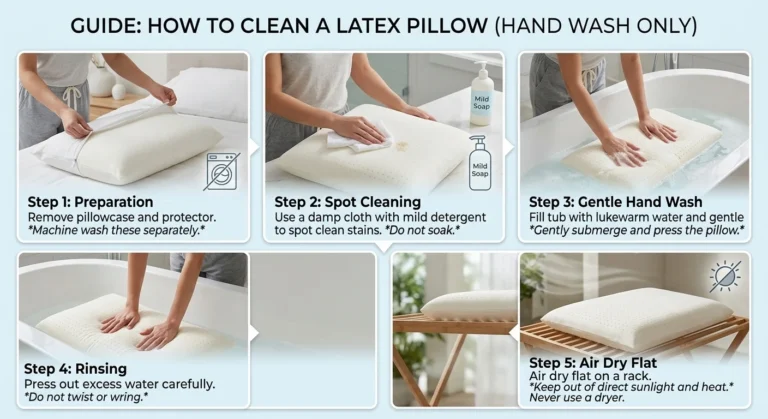
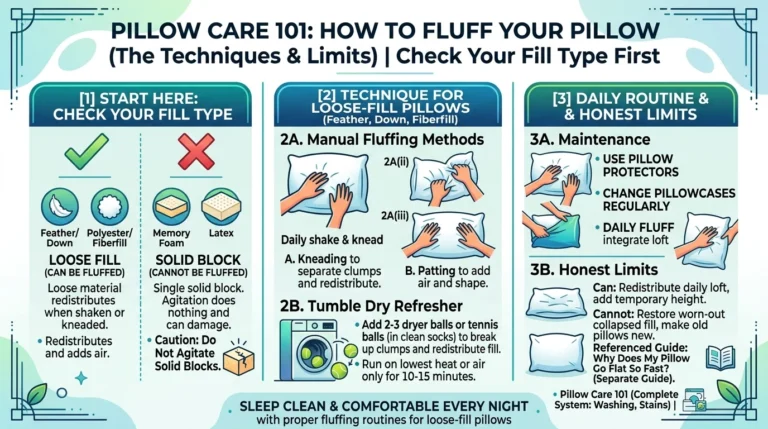
If you have a latex pillow rather than memory foam, the rules overlap but are not identical, and the differences matter. See How to Clean a Latex Pillow. For how all of this fits into a routine, Pillow Care 101 is the overview.
FAQ
Can I ever put a memory foam pillow in the washing machine, even on delicate?
No. Delicate reduces the agitation but does not eliminate it, and the spin cycle is the more damaging part. There is no machine setting that makes this safe.
Can I use a dryer on the no-heat or air-fluff setting?
It is still tumbling, which is the mechanical problem. Air drying with a fan achieves the same thing without the risk.
How often should a memory foam pillow be cleaned?
The dry refresh can be done every month or two. A full hand wash is rarely needed and should be treated as an occasional event rather than a schedule.
My foam pillow got soaked. Can I save it?
Possibly, if you dry it thoroughly and slowly with ventilation and no heat. The risk is that a large volume of water sitting in the center for days produces a smell you cannot get out.
Why does my memory foam pillow smell after I cleaned it?
Almost always because it was not dry all the way through. That is a common enough outcome that it has its own page: Why Does My Pillow Smell After Washing It?