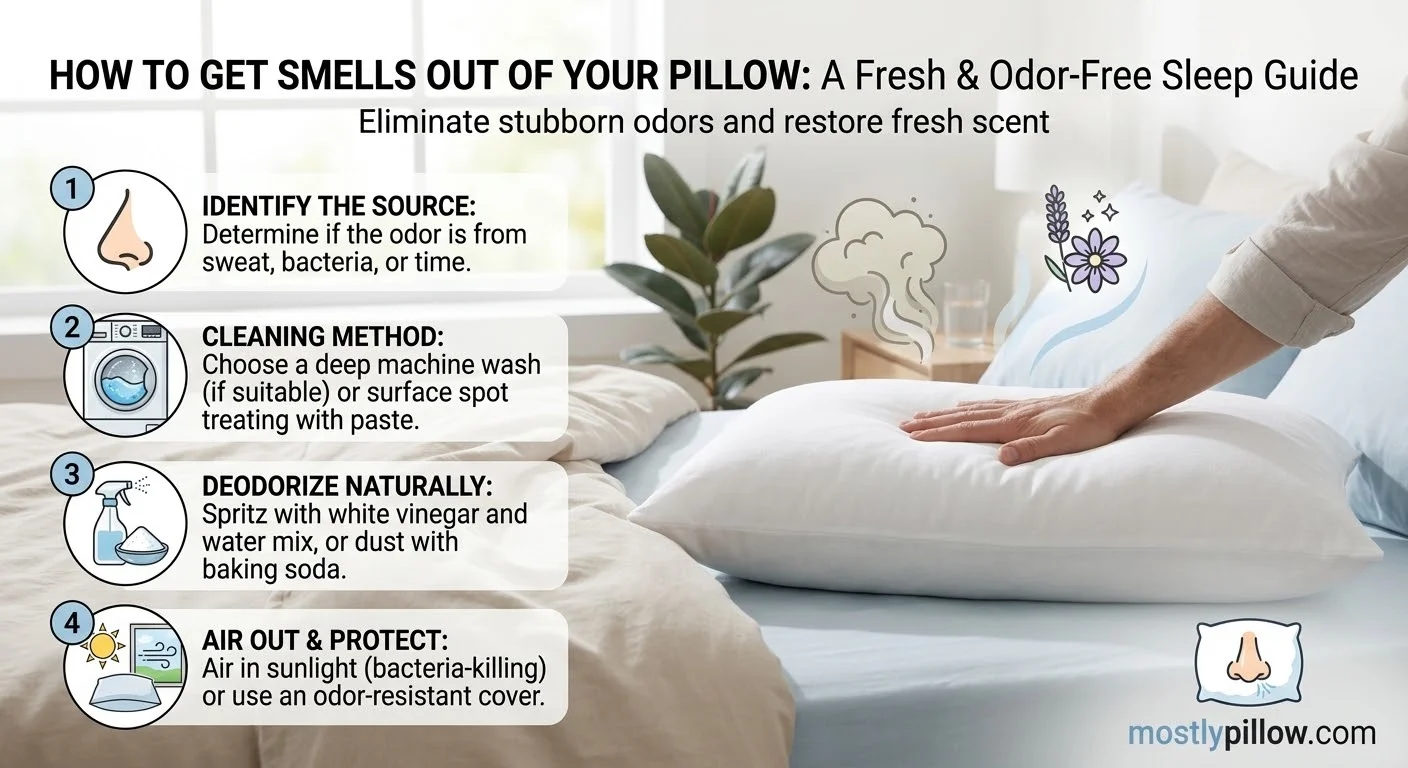
How to Get Smells Out of a Pillow
Start by working out what kind of smell it is. A stale, sweaty smell is accumulated body oil and responds to baking soda, airing out, and washing if the fill allows it. A sharp chemical smell on a new foam pillow is off-gassing and mostly needs air and time. A damp, musty smell means moisture is still in the pillow, which is a drying problem rather than a cleaning one. Dry methods, baking soda and fresh air, are safe on every fill. Wet methods are only for pillows that can actually be washed.
Which smell is this?
Almost every article on this subject opens with methods. That is backwards, because three unrelated problems arrive at the same search box and only one of them responds to a deodorizing method.
| What it smells like | What it usually means | Start here |
|---|---|---|
| Stale, faintly sour, like an unwashed shirt | Accumulated sweat and body oil in the fill | Dry methods below, then wash if the fill allows |
| Sharp, chemical, plasticky, on a recently bought pillow | Off-gassing from new foam | Air and time. See the off-gassing section |
| Damp, musty, like a cellar, especially after you washed it | Moisture still inside the fill | Why Does My Pillow Smell After Washing It? |
| Soapy, flat, with a stiff feel to the fill | Detergent residue from a previous wash | A rinse-only pass, covered on the page above |
Spend thirty seconds on this before you spend an afternoon on a method. The rest of this page assumes you have landed on the first case, accumulated body odor, which is the most common.
Dry method 1: baking soda
This is the first thing to try for almost any pillow, because it works on the most common odor and it is safe on every fill including foam, latex and buckwheat casings.
- Strip the pillowcase and any protector.
- Sprinkle baking soda evenly over one side of the pillow. An even dusting, not a pile.
- Leave it for about an hour.
- Vacuum it off thoroughly with an upholstery attachment.
- Turn the pillow over and repeat on the other side.
Baking soda absorbs odor compounds rather than covering them with a fragrance, which is why the result is a pillow that smells like nothing rather than a pillow that smells like something else. Nothing gets wet, so there is no drying risk and no possibility of damaging a fill.
If the smell is faint, this often finishes the job on its own. If it is strong, this is still the right first step, because it reduces the load before anything more involved.
Dry method 2: fresh air and sunlight
Free, and more effective than it sounds.
Take the pillow outside on a dry day, or put it near an open window with real airflow. A few hours of moving air does two useful things: it carries off volatile odor compounds, and it drives out ambient moisture that the fill has picked up from a humid room. Sunlight adds to that, and ultraviolet light has a general inhibiting effect on the microbial growth that produces musty smells.
Two cautions. Latex pillows should stay out of direct sunlight, because ultraviolet light degrades the material. Shade with good airflow is the right version for latex. And prolonged strong sun is not ideal for memory foam either, so treat sun as a finishing touch for those fills rather than the main method.
For down, fiberfill and cotton, a few hours in the sun is an excellent and underused option.
Dry method 3: a light vinegar mist
A step up from baking soda, and still safe on most fills because nothing gets soaked.
Mix equal parts white vinegar and cool water in a spray bottle. Mist lightly over both sides of the pillow. Lightly is the operative word: you are dampening the surface, not wetting the fill. Then let the pillow air dry completely, ideally with airflow, before the pillowcase goes anywhere near it.
Vinegar neutralizes odor-causing residue rather than masking it, and the vinegar smell itself disappears entirely as the pillow dries. If it is still there, the pillow is not dry yet.
Never combine vinegar with a bleach-based product. That combination can produce chlorine gas. Use one or the other, and never in sequence on a damp pillow either.
Wet methods, and who they are for
If the fill is washable and the dry methods have not been enough, washing is the next step. This is where the fill check becomes non-negotiable.
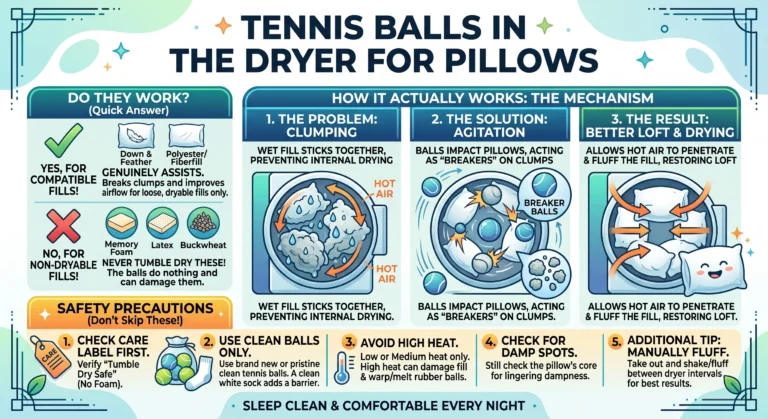
Washable in a machine: down, feather, fiberfill and polyester. See How to Wash Pillows in a Washing Machine, which covers the settings and the fills that tolerate them.
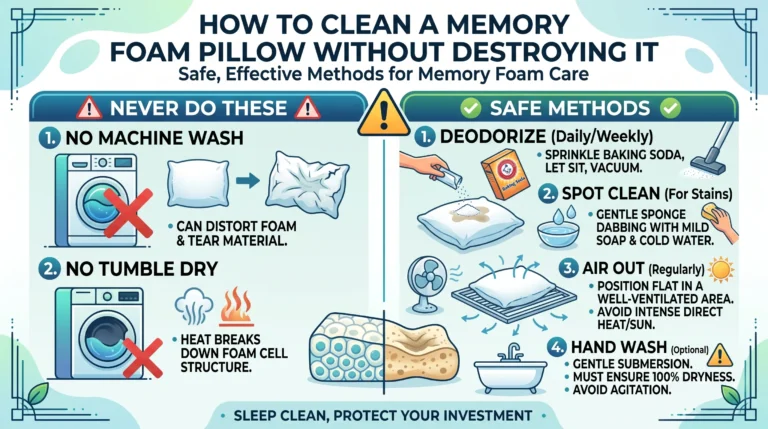
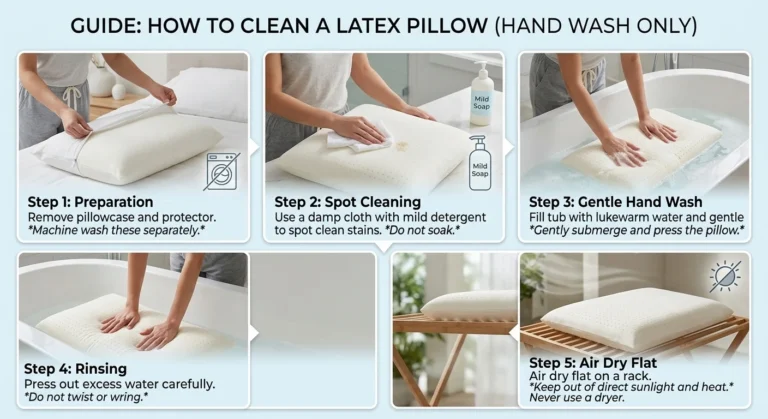
Hand wash only: memory foam and latex. See How to Clean a Memory Foam Pillow.
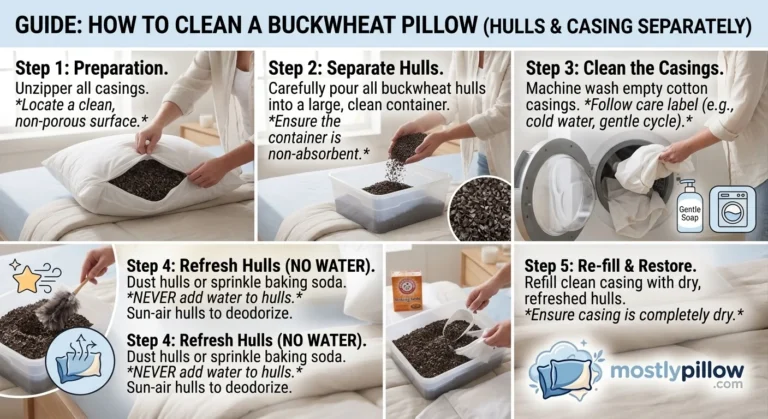
Never wash: buckwheat hulls. The casing washes, the hulls are sunned. How to Clean a Buckwheat Pillow covers it.
For a washable pillow with a persistent odor, a soak in warm water with an oxygen-based laundry powder before the wash cycle is a commonly recommended option, and it is more effective on set-in body odor than detergent alone.
One warning that applies to every wet method: a wet pillow that is not dried completely will smell worse than it did before you started. More on that below.
The new-pillow chemical smell
If the pillow is new and the smell is sharp and chemical rather than organic, none of the above is the answer.
New foam pillows, both memory foam and some latex, release a chemical odor when they are first unwrapped. It is a manufacturing residue rather than anything the pillow has picked up, and the standard response is air and time. Unwrap the pillow completely, put it somewhere with real airflow and out of direct sun, and leave it for a few days. Most of the smell dissipates on its own.
Do not wash a new foam pillow to solve this. You will add a multi-day drying problem to a problem that was going to resolve by itself.
Baking soda can speed it along slightly. Time is doing most of the work.
The musty smell, and why it is a different problem
A damp, musty, cellar-like smell is not an odor problem with an odor solution. It is moisture, and until the moisture leaves, every deodorizing method buys you a few days at most.
This is the single most common reason people cycle through four methods and stay frustrated. Baking soda applied to a pillow with wet fill absorbs the smell that is currently in the air around it, and the fill promptly produces more.
The fix is drying, done properly and verified. That has its own page because it is a common enough outcome to deserve one: Why Does My Pillow Smell After Washing It? covers both the diagnosis and the correction, including the technique by fill type.
Prevention that actually reduces odor buildup
Odor and yellowing come from the same source, which means the same habits address both. The residue you can smell is the residue you can eventually see, and Why Do Pillows Turn Yellow in the First Place? covers the shared cause.
Change pillowcases about once a week. This is the highest-value habit on the list. It reduces the oils, sweat and dust reaching the pillow itself.
Use a washable protector under the case. A second barrier, and one that washes as easily as a sheet.
Choose breathable, moisture-wicking pillowcase fabric. Less moisture held against the fill means less of what produces odor in the first place.
Air the pillow out regularly. Ten minutes of the bed unmade before you make it lets overnight moisture leave rather than sitting in the fill all day.
Do not go to bed with damp hair. Moisture plus fill plus eight hours is the recipe for the musty version of this problem.
Washing the pillow itself on a sensible schedule, rather than waiting for a smell to appear, is the last piece of this.
When a smell means the pillow is finished
Most pillow odor articles imply that something on the list will work. Sometimes nothing does, and knowing when to stop is worth more than a fifth method.
If a pillow has been aired, treated with baking soda, washed if its fill allows it, and fully dried, and it still smells, the odor is in the fill rather than on it. At that point you are not cleaning a pillow, you are managing one. That is a replacement decision.
The same applies if there is visible mold on or in the fill. Mold in a pillow's filling is difficult to remove reliably, and replacing the pillow is the sensible call. If you have a health question about mold or about anything you have been sleeping on, that belongs with a clinician rather than with a cleaning guide.
For how all of this fits into an ongoing routine, Pillow Care 101 is the overview.
FAQ
Does baking soda actually work, or does it just mask the smell?
It absorbs odor compounds rather than covering them with fragrance, which is why a pillow treated with it smells neutral rather than perfumed.
Can I use a fabric refresher spray instead?
Those add a fragrance on top of the smell rather than removing it, and the underlying odor returns as the fragrance fades. They also add moisture to a fill, which is the opposite of helpful if the problem is dampness.
Why does my pillow smell only in the morning?
Overnight moisture and body heat make existing residue more noticeable. Airing the bed before making it, and a weekly pillowcase change, usually addresses this.
How long does a new foam pillow smell for?
It varies by pillow. Unwrapped and left somewhere with real airflow, most of it dissipates over a few days. Washing it is not the answer and creates a bigger problem.
Can I put vinegar directly in the wash instead of misting?
For a washable pillow, vinegar in a wash cycle is a common treatment for a musty smell. Never combine it with a bleach-based product in the same wash.
Is a smelly pillow a health risk?
This site does not make health claims, and a question about health effects is one for a clinician. The practical answer is that a pillow which does not respond to cleaning and drying is one to replace.