How to Clean a Latex Pillow
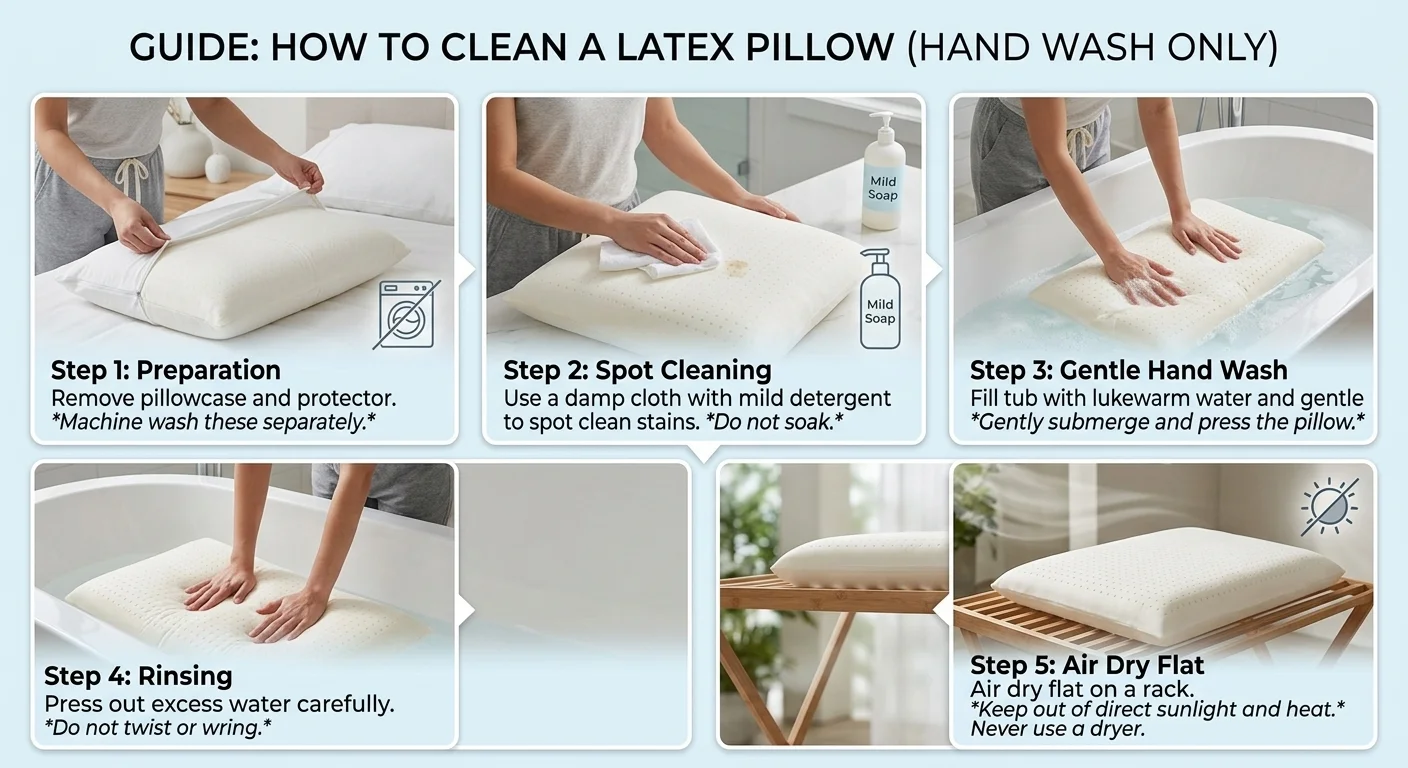
A latex pillow should never go in a washing machine or a dryer, and it should never be wrung, twisted or stretched. Wet latex is much weaker than dry latex and tears under its own weight. Clean marks by dabbing with a barely damp cloth and a little mild detergent. If the whole pillow needs washing, press it gently in lukewarm water with your palms rather than agitating it, then press the water out between towels, supporting the pillow from underneath the whole time. Dry it flat, out of direct sunlight, and give it longer than you expect.
If you are not certain which fill you have, How to Wash Pillows in a Washing Machine sorts that out first.
The rules, and the reason behind each one
Latex care is usually presented as a list of prohibitions. Lists of prohibitions are hard to follow because there is always a situation the list did not anticipate. The mechanisms are easier to carry around.
| Rule | The reason |
|---|---|
| No washing machine | Agitation and the spin cycle tear latex that is already weakened by water |
| No dryer | Heat degrades the material and it does not recover |
| Never wring, twist or stretch | Latex fails in tension, not in compression |
| Dab, do not scrub | Pressure breaks down the structure at the surface |
| Do not leave it soaking | Prolonged saturation adds weight and weakens the whole block |
| Dry flat, out of direct sun | Ultraviolet light and heat both degrade latex over time |
Everything below is an application of those six.
Why wet latex tears
Dry latex is springy and forgiving. It is the reason a latex pillow feels the way it does: it resists compression and springs back.
Water changes that. A saturated latex pillow is heavy, and the material's resistance to being pulled apart drops sharply. This is why the instructions are so insistent about never lifting a wet latex pillow by one end or one corner. The weight of the water in the rest of the pillow acts on whatever part you are holding, and the material gives way.
The practical rule that follows: whenever the pillow is wet, it is supported from underneath along its whole length. Two flat hands, or a towel underneath it acting as a sling. Never one hand, never a grip, never a lift by the edge.
The same mechanism explains why you press rather than squeeze. Pressing loads the material in compression, which it tolerates. Squeezing and wringing load it in tension and shear, which it does not.
Why direct sunlight is a problem for latex specifically
Nearly every latex care page says to keep the pillow out of direct sunlight. Almost none of them say why, so people treat it as optional and dry the pillow on a sunny balcony.
Latex degrades under ultraviolet light. The exposure breaks the material down at the surface, and the visible result is a pillow that goes crumbly, dusty or discolored at the edges. Heat from the sun compounds it.
This is a genuine difference from other fills. Sunning a fiberfill or down pillow is a reasonable finishing step. Sunning a latex pillow shortens its life. Shade and airflow do the same drying job without the damage.
Routine care that avoids washing entirely
Most latex pillows never need a full wash if the routine is right.
Use a protector and a pillowcase. The protector takes the sweat and oil. Latex itself is difficult to clean, so keeping things off it is worth far more than any cleaning method.
Air it out. Once a month, strip the pillow and leave it uncovered somewhere with airflow for a few hours, out of direct sun. This handles most of what would otherwise become a smell.
Vacuum it. An upholstery attachment lifts dust from the surface without touching the material's structure.
Baking soda for odor. Sprinkle it over the surface, leave it 30 minutes to an hour, then brush it off gently or lift it with an upholstery vacuum attachment. Repeat on the other side. This is safe and dry, which makes it the first thing to reach for.
Spot cleaning a mark
For a stain or a small spill:
- Mix a little mild detergent or liquid soap into warm water in a bowl.
- Dip a clean cloth or sponge and wring it out until it is barely damp. Not dripping.
- Dab the stained area gently. Do not scrub and do not press hard, because pressure breaks down the latex structure.
- Wipe the area with a second cloth dampened in plain water to lift the soap residue.
- Blot dry with a clean towel and let the spot air dry completely before covering the pillow.
Getting to a mark early is worth a lot here. A fresh spill lifts with a dab. A set stain in latex often does not come out at all, because the aggressive methods that would remove it are the methods that damage the material.
Washing the whole pillow by hand
Two things in the checked guidance appear to contradict each other: never soak a latex pillow, and here is how to wash one in a tub. Both are correct, and the reconciliation is simple.
Never leave a latex pillow sitting in water. Prolonged saturation is what weakens it dangerously.
A brief, supported, hands-on wash is a different thing. The pillow is in the water while you are working on it, and it comes out as soon as you are done.
The method:
- Fill a bathtub or large basin with lukewarm water and dissolve a small amount of mild detergent suitable for delicates.
- Lower the pillow in with both hands. Press down on it with flat palms so the solution moves through the foam, then release so it draws clean solution back in. Repeat this a few times. This is the whole washing action. Do not twist, wring or scrunch.
- Drain and refill with clean water. Press and release again to push the detergent out. Repeat until the water stays clear.
- Press the pillow down against the bottom of the tub to expel as much water as you can before lifting it.
- Lift it flat, with both hands underneath, or slide a towel under it and lift the towel.
- Lay it on a large dry towel, fold the towel over, and press down along its length. Water embeds deep in latex, so this takes several passes with fresh towels before it stops coming out.
The general principles behind this, including the rinse discipline, are covered in Hand-Washing and Spot-Cleaning Pillows That Cannot Go in a Machine.
Drying latex without damaging it
Latex is among the slowest common fills to dry, and it has the narrowest set of permitted methods: no heat, no tumbling, no direct sun.
Lay the pillow flat on a drying rack so air reaches it from below. If you only have a flat surface, put a towel underneath and swap it out as it dampens. Turn the pillow every few hours. A fan in the room makes a large difference. A well-ventilated shaded spot outdoors is ideal in dry weather.
Do not stand it on edge. A wet latex pillow standing up is carrying its own weight in tension, which is the loading it fails under.
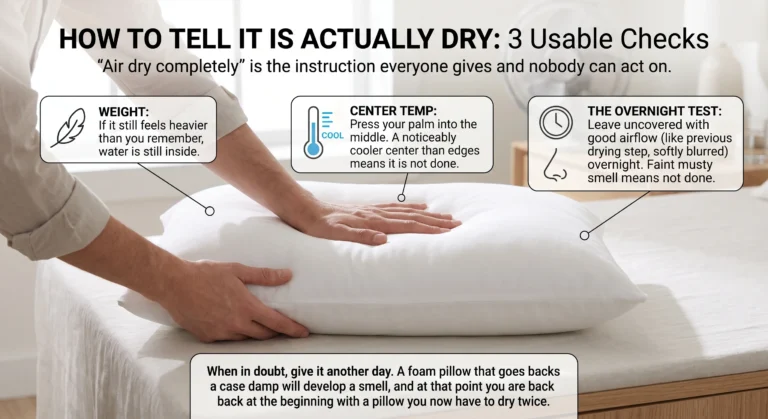
Give it longer than you think. Press your palm into the center and hold it: if the middle feels cool, moisture is still evaporating from it. For general drying guidance across fills, see How to Dry Pillows Without Ruining the Fill.
Latex and memory foam: what is genuinely different
These two get treated as one category, and plenty of people are not sure which they own. The care rules overlap but not completely.
| Latex | Memory foam | |
|---|---|---|
| Machine wash | No | No |
| Dryer | No | No |
| Hand wash | Yes, brief and supported | Yes |
| Wringing or twisting | No, tears readily when wet | No |
| Direct sunlight | Avoid, ultraviolet degrades it | Brief exposure to finish drying is tolerable |
| Feel when new | Springy, resists and pushes back | Slow to recover, molds to shape |
| Typical failure mode | Crumbling, surface breakdown | Loss of resilience, permanent flattening |
If yours molds slowly to the shape of your hand and takes a moment to recover, it is memory foam and How to Clean a Memory Foam Pillow is your page. If it pushes back immediately, it is latex.
When a latex pillow is past cleaning
Latex breaks down with age. When it does, the signs are physical rather than cosmetic: crumbling at the edges, a fine dust when you handle it, or a section that has gone soft and no longer springs back. Cleaning does not reverse any of that, and washing a pillow that has begun to crumble will accelerate it.
If the only problem is a smell and the material is otherwise sound, start dry. How to Get Smells Out of a Pillow sorts odors by type and most of the answers there do not involve water at all. For the full care routine, Pillow Care 101 is the overview.
FAQ
Can I put a latex pillow in the washing machine on a gentle cycle?
No. Gentle reduces agitation but does not remove it, and the spin cycle is the bigger risk. Wet latex tears under mechanical stress regardless of the setting.
How often should a latex pillow be washed?
Rarely. With a protector and regular airing, most latex pillows go a long time between full washes. Spot clean as needed and reserve a full wash for a genuine problem.
Can I dry a latex pillow outside?
In the shade with good airflow, yes, and that is a good option. In direct sun, no, because ultraviolet light degrades the material.
Is a natural latex pillow cleaned differently from a synthetic or blended one?
The handling rules are the same: no machine, no dryer, no wringing, no direct sun. Follow the manufacturer's instructions if you have them, since they are specific to your pillow.
I am allergic to latex. Is a latex pillow safe for me?
That is a medical question and not one this site can answer. Please raise it with a clinician.