How Often Should You Replace Your Pillow?
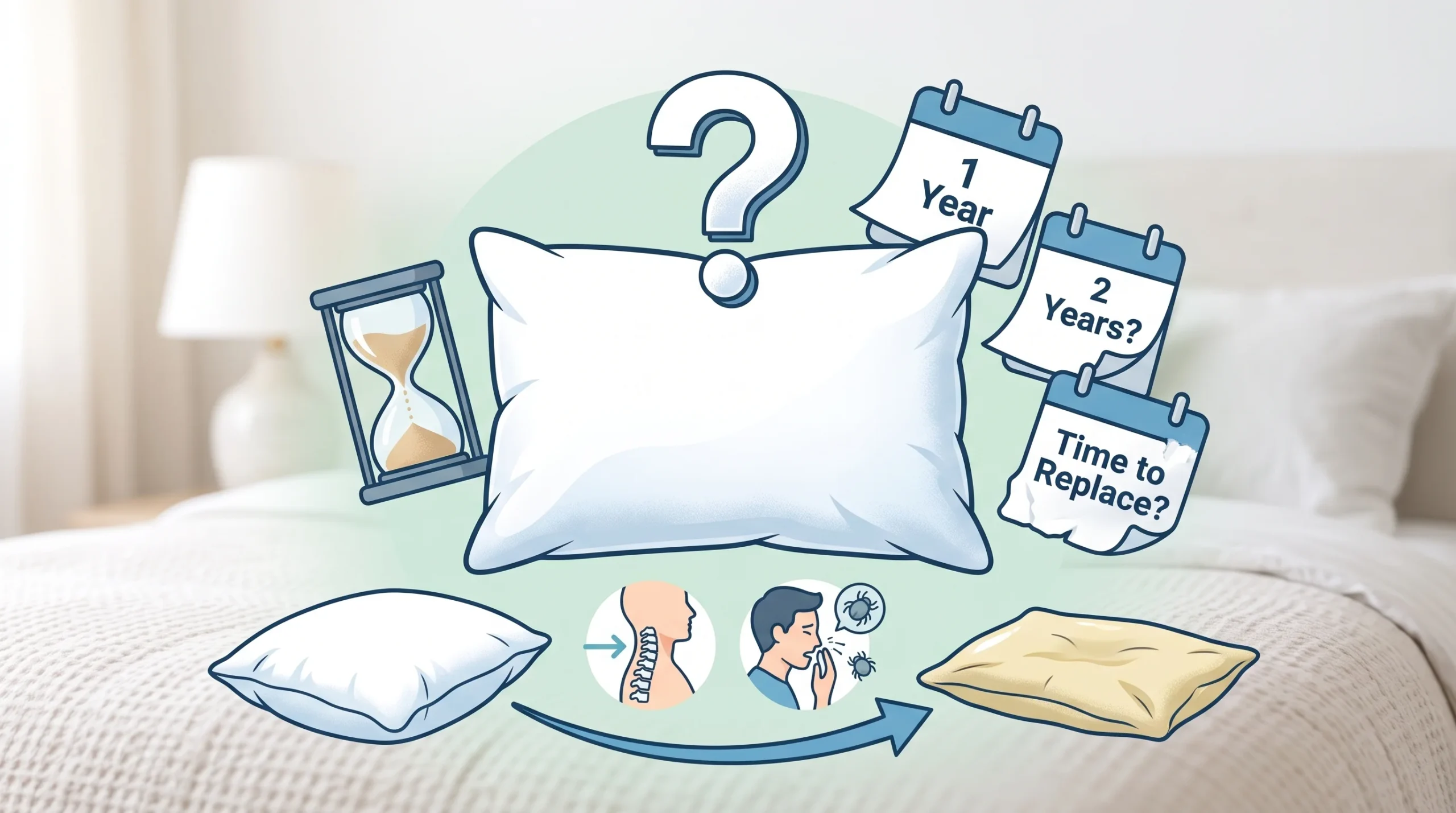
There's no single correct interval, and any source that gives you one flat number for every pillow is oversimplifying. Replacement timing depends heavily on what the pillow is filled with, and the ranges differ enough between fills that they're barely comparable. Sleep Foundation, an independent sleep research and education organization, gives rough guidelines of 2 to 3 years for memory foam and polyfoam, 1 to 3 years for down and feather, 1 to 2 years for down alternative, 6 months to 2 years for polyester, and 2 to 4 years for latex, while stating plainly that these are general guidelines rather than fixed rules, since material quality and how well a pillow is cared for both move the number. Check your specific pillow's care label or manufacturer information first; the ranges below are a fallback for when that information isn't available.
Why the ranges are this wide
Two pillows filled with the same material can wear out at noticeably different rates depending on the quality of that material, how the pillow is used, and how it's cared for. A higher-density foam or a higher fill-power down holds up longer than a cheaper equivalent in the same category. A pillow that's regularly washed and properly dried, using the method that actually matches its fill, tends to last closer to the long end of its range. One that's never washed, or washed the wrong way for its material, tends to wear out faster, sometimes well before the interval a general guideline would suggest.
The range, by fill type
| Fill type | General range (Sleep Foundation) | What mainly determines where in that range yours lands |
|---|---|---|
| Memory foam / polyfoam | 2 to 3 years | Foam density, and whether it's kept out of water (which can degrade foam structure over time) |
| Down / feather | 1 to 3 years | Fill power and quality, proper washing and complete drying |
| Down alternative | 1 to 2 years | Fiber quality; generally shorter-lived than true down |
| Polyester / fiberfill | 6 months to 2 years | Among the least durable common fills; usage intensity matters a lot |
| Latex | 2 to 4 years | Generally the most durable common fill, though heat and sun exposure can shorten this |
| Buckwheat | Hulls don't wear out the same way; periodic top-up rather than full replacement is more typical | Hull quantity and freshness, not a fixed replacement clock |
Treat these as a starting reference, not a countdown. The physical condition of your specific pillow is a more reliable signal than a number on a calendar; see How to Tell When a Pillow Is Worn Out: The Fold Test and Four Other Checks for how to check that directly.
Why sources disagree with each other
Search this question and you'll find numbers ranging from about 18 months to three years used as a general, material-agnostic rule of thumb, alongside the more granular by-fill guidance above. Both can be true at once: an "every couple of years" rule of thumb is a reasonable average across all pillow types, while the real number for any specific pillow depends on what's actually inside it. Neither figure is governed by a regulatory body or a single agreed standard; they're guidelines from sleep and bedding organizations, not fixed facts, which is exactly why phrasing this as a range rather than a single number is the honest answer.
Care extends the range; poor care shortens it
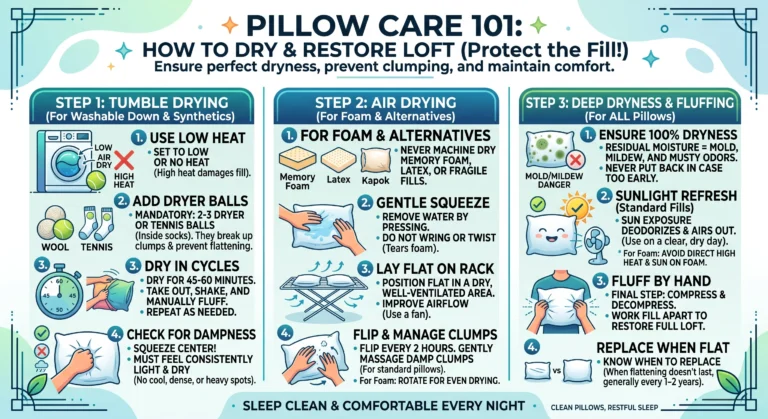
Within any fill type's range, how a pillow is treated matters. Washing on the correct schedule and using the drying method that matches the fill (never machine-drying foam or latex, for instance, and making sure down and feather are dried completely through the core, not just on the surface) helps a pillow reach the longer end of its expected range. Skipping care entirely, or using the wrong method for the fill, tends to push a pillow toward the shorter end, sometimes well before the "expected" interval. The full care system, organized by fill type, is in Pillow Care 101, and a simple routine for staying on top of it is in The Pillow Care Calendar.
Does a pillow protector change the timeline?
A protector or pillowcase doesn't stop a pillow from wearing out, since the fill inside still compresses and breaks down through ordinary use regardless of what's covering it. What a protector genuinely does is reduce how much sweat, oil and dust reach the fill directly, which can slow the buildup that leads to odor and staining and, indirectly, keep a pillow usable for longer within its expected range rather than pushing it toward early replacement because of soiling rather than actual wear. Treat a protector as a way to protect the pillow's condition between washes, not as something that extends its physical lifespan on its own.
Replacing the whole pillow versus just the cover
Not every "worn out" pillow needs to be thrown away entirely. If the cover has yellowed or torn but the fill inside still passes the fold test and shows no odor or lumps, a new cover or protector can be a reasonable middle step rather than full replacement, particularly for down and feather pillows where a good insert is the more expensive part. If the fill itself has failed the physical checks, though, a new cover won't fix what's actually wrong.
When to check sooner than the calendar suggests
A pillow doesn't need to wait for its "expected" interval to be checked. Morning neck or shoulder stiffness that eases through the day, a persistent odor that survives a proper wash, or visible lumps are all reasons to run a physical check now rather than waiting out a general timeframe. Is Your Pillow the Problem? A Symptom-First Troubleshooting Guide walks through the fuller set of symptoms worth checking against.
FAQ
Is it true you should replace your pillow every year?
Not as a universal rule. Some fills, like polyester, sit at the shorter end of common guidance (as short as 6 months in heavy use), while others, like latex, are typically expected to last considerably longer, up to around 4 years per Sleep Foundation's general range. A single "every year" rule doesn't hold across materials.
Does washing my pillow regularly extend its life?
Generally yes, provided it's washed and, critically, fully dried using the method appropriate for its fill. Skipping washing, or drying it incorrectly, tends to shorten how long a pillow stays usable within its expected range.
How do I know which fill my pillow has if I've lost the label?
Feel and behavior are the best clues without a label: memory foam and latex are dense and slowly spring back when pressed; down and feather compress almost flat and rustle; polyester and fiberfill feel uniformly soft throughout; buckwheat is heavy and shifts audibly when moved.
Should I replace a pillow that still looks fine?
Looking fine on a made bed and functioning properly at 2am are different things. A physical check, like the fold test, is more reliable than appearance alone. See How to Tell When a Pillow Is Worn Out for the full set of checks.
Do more expensive pillows last longer?
Generally, higher-quality materials within a given fill category (denser foam, higher fill-power down) tend to hold up longer and land closer to the top of their expected range, but price alone isn't a guarantee; care matters just as much.