Pillow Slides Off Bed Every Night? Causes and Fixes
Short answer: when a pillow slides off the bed every night, the cause is almost always one of four things: a slippery pillowcase on a slippery sheet, a gap between the mattress and headboard, a mattress that is shifting or tilted, or a pillow that is too light or too flat to stay put under your movement. The fix depends on which way the pillow goes. Up and behind the headboard points at the gap or the mattress. Out to the side or onto the floor points at friction and how you move. Start with the direction, and the fix usually follows.
This is a mechanical problem, not a mystery, and it rarely needs anything bought. Here is how to work out which of the four you have.
Why your pillow slides off the bed: the four causes
Nearly every version of this problem comes down to one or more of these:
- Low friction. Silky or satin pillowcases, sateen or microfiber sheets, and smooth pillow shells all slide easily against each other. Two slippery surfaces together make the worst pairing.
- A gap at the head of the bed. Any space between the mattress and the headboard or wall is somewhere for a pillow to go. Pillows drift toward it with every push and eventually drop in.
- A moving or tilted mattress. A mattress that creeps toward the foot of the bed opens a gap at the head. A bed that is not level, or a frame that tilts slightly toward the headboard, lets pillows travel that way over a night.
- The pillow and the sleeper. Light, soft pillows move more easily than dense ones. A pillow that has gone flat gives you less to rest on, so you tend to push and bunch it. Restless sleepers, people who sleep with an arm under the pillow, and people who switch positions often all shove the pillow around without knowing it.
Most people have two of these at once, which is why a single fix sometimes only half works.
Diagnose by direction: where does the pillow end up?
This is the quickest way to narrow it down, and it is the part most advice skips. Notice where the pillow is when you wake up for a few mornings in a row.
| Where the pillow ends up | Most likely cause | Where to start |
|---|---|---|
| Behind the headboard or down the gap by the wall | A gap at the head of the bed, often widened by a mattress that has slid | Close the gap; stop the mattress moving |
| Pushed up toward the headboard but still on the bed | Mattress tilt, or you sliding down the bed during the night | Check the bed is level; look at your sleeping position |
| Out to the side or on the floor | Low friction and movement, especially with silky bedding | Add grip; check pillow weight and loft |
| Still on the bed but no longer under your head | You are moving off it, often because it is too flat or too high | Check the pillow's height and condition |
If you share a bed and only one side has the problem, compare the two sides. A different pillow, a different pillowcase, or a different sleeping habit on that side usually explains it.
Fixing a slippery surface
If the pillow slides sideways or onto the floor, friction is the first thing to change.
- Swap the pillowcase fabric. Cotton percale, flannel and linen have more texture than silk, satin or sateen, and grip the sheet better. If you prefer a silky case against your face, a thin cotton case underneath it adds grip between the pillow and the silky layer.
- Look at the sheet as well. A slippery case on a slippery fitted sheet is the hardest combination. Changing either one helps.
- Put a grippy layer under the pillow. A piece of rubberized shelf liner or a non-slip rug pad cut to size, placed between the pillow and the fitted sheet, adds friction without changing what touches your face. Check it lies flat and is not something you will feel through the pillow.
- Add a textured pillow protector. A cotton protector adds a second layer of fabric between a smooth pillow shell and the pillowcase, so the pillow has less room to slip inside its own case. It also keeps the pillow cleaner, which our pillow care guide covers in more detail.
Closing the gap at the head of the bed
If the pillow disappears behind the headboard, no amount of grip will fully solve it while the gap is there.
- Push the mattress back against the headboard, and check whether it stays there. If it has crept forward again within a few days, the mattress is moving, which is the next section.
- Fill the gap. A rolled towel, a foam pool noodle or a long draft stopper tucked along the head of the mattress, under the fitted sheet, makes a low barrier. Purpose-made foam gap fillers do the same job.
- Move the bed against a wall if the room allows, with the head fully against it, so there is nowhere for the pillow to go.
- Raise a low mattress. If the mattress sits below the bottom edge of the headboard panel, there can be a slot the pillow drops through. A topper can bring the sleeping surface up a little, though it changes how the bed feels.
These fixes are for adult beds. For babies under 1, the U.S. National Institutes of Health Safe to Sleep campaign (read September 25, 2026) advises removing "everything from baby's sleep area, except a fitted sheet covering the mattress," and links bedding other than a fitted sheet to serious injuries and deaths. Pillows, rolled towels and gap fillers do not belong in an infant's sleep space. A pediatrician is the right person to ask about any infant sleep setup.
Stopping a mattress that moves or tilts
A mattress that walks toward the foot of the bed will keep reopening the gap, however often you push it back.
- Add grip between mattress and base. Non-slip mattress pads or rug gripper material between the mattress and the frame or foundation reduce creep. Hook-and-loop strips are another option some people use on flat bases.
- Check the frame. A missing stopper bar, a loose slat, or a frame that has spread apart can let a mattress move. If the frame came with a retainer bar or foot-end lip, make sure it is fitted.
- Check the bed is level. Uneven floors, a leg that has sunk into carpet, or an adjustable base that is not fully flat can all tilt the bed toward the headboard. A small level on the mattress or frame will show it. Pillows, and sleepers, travel downhill over a night.
When the problem is the pillow, or how you sleep on it
Sometimes the pillow stays on the bed and simply ends up anywhere but under your head. That is usually about the pillow itself.
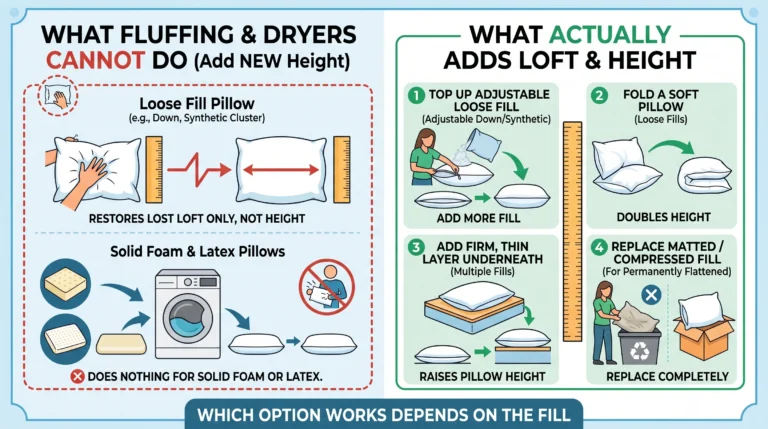
- A flat pillow gets pushed around. When a pillow has lost its loft, many people fold it, bunch it or shove it to get more height, and it ends up somewhere else by morning. Some fills can be revived; how to fluff a pillow explains which ones. Others have simply worn out, and how often to replace your pillow covers when that point arrives for each fill type.
- A pillow that is too high can make you shift off it during the night, especially if you roll from side to back.
- Light fills move more. Down, feather and loose fiber pillows weigh less and deform more easily than solid foam or latex, so they get pushed around more by the same movement.
- Arm-under-pillow sleepers lift and push the pillow every time they shift. A pillow under the fitted sheet stays put for some people but does not suit this habit.
- Sliding down the bed. If you wake up lower in the bed than you started, the pillow has not moved so much as you have. This is common on beds tilted toward the foot or on soft mattresses that slope toward the middle.
What not to bother with
Some fixes are more trouble than the problem. Pillow straps and clips that hold two pillows together make them heavier and harder to push around, but the strap can be felt against your face. Pinning or sewing a pillow to a sheet makes washing a chore. Tucking a pillow under the fitted sheet works for some sleepers, but it can make the pillow feel firmer and flatter. None of these are wrong, but try the free ones first: a different pillowcase, pushing the mattress back, and a rolled towel in the gap.
A simple order to work through
- Note where the pillow ends up for three or four mornings.
- If it is behind the headboard, push the mattress back and fill the gap.
- If the mattress keeps creeping forward, add grip under it and check the frame.
- If it slides sideways, change the pillowcase or sheet fabric, or add a grippy layer.
- If it is simply not under your head, look at the pillow's height and condition.
Change one thing at a time. If you change three things at once and the problem stops, you will not know which one mattered, and you may keep a fix you did not need.
FAQ
Why does my pillow keep falling behind the bed?
Usually because there is a gap between the mattress and the headboard or wall, and it grows when the mattress creeps toward the foot of the bed. Pushing the mattress back, stopping it from moving, and filling the gap with a rolled towel or foam filler under the fitted sheet usually solves it.
Do silk pillowcases make pillows slide more?
Silk and satin are smooth fabrics, so they slide more easily against sheets than textured cotton, flannel or linen. If you want to keep a silky case, a thin cotton case underneath it adds grip between the pillow and the silk.
How do I stop my pillow sliding off the side of the bed?
Add friction: a cotton or flannel pillowcase, a less slippery sheet, or a piece of non-slip liner under the pillow. If the pillow is very light or very flat, it will also move more, so check its condition.
Why does my pillow slide up toward the headboard?
Often because the bed is slightly tilted toward the headboard, or because you slide down the bed during the night and push the pillow up as you go. Check the bed is level and the mattress is not sagging toward the middle.
Is it safe to use pool noodles or towels to fill the gap?
For an adult bed, many people use them under the fitted sheet. For babies under 1, the NIH Safe to Sleep campaign advises keeping everything except a fitted sheet out of the sleep area, so these fillers do not belong in a crib or infant sleep space.
A pillow that slides every night is annoying, not serious, and the fix is nearly always cheap. Watch where it goes, change one thing at a time, and you will usually have it solved within a week.