Pillow for Snoring: What It Can and Cannot Do
Short answer: a pillow for snoring can help some people, but only with one kind of snoring. Snoring that gets worse when you lie on your back is positional, and health sources such as the NHS and Cleveland Clinic list side sleeping and raising the head during sleep among the things that may reduce it. A pillow can support those positions. It cannot fix snoring caused by alcohol, a blocked nose, the shape of your airway or sleep apnea, and it is not a treatment for any of them.
That ceiling matters, because much of what ranks for this topic is written to sell a pillow. This article covers the warning signs first, then how a pillow's height and shape relate to snoring, and how to tell whether yours is the kind a pillow can touch.
First: when snoring is a reason to see a doctor
Before anything about pillows, the signs that snoring may be more than noise. The NHS page on snoring (reviewed August 4, 2023, read September 25, 2026) advises seeing a GP if changing your habits has not helped, if snoring is affecting your life, or if you have daytime drowsiness, or your "breathing stops and starts while you sleep, or you make gasping or choking noises while you sleep." The NHS names those as possible signs of sleep apnoea.
Cleveland Clinic's snoring page (last reviewed June 4, 2026, read September 25, 2026) gives a similar list: stopping breathing during sleep or gasping, loud or frequent snoring, and daytime fatigue or headaches. It notes that snoring can be a sign of obstructive sleep apnea.
If any of those apply, the pillow is not the first question. A doctor, or a sleep clinic they refer you to, is. A pillow may still be part of the picture later, but only a clinician can tell you whether sleep apnea is involved, and a pillow is not a substitute for that check.
Why sleeping position changes snoring
The NHS describes snoring as the sound of your tongue, mouth, throat or nasal airways vibrating as you breathe, because those tissues relax and narrow during sleep. Cleveland Clinic lists sleeping on your back as one risk factor among several, alongside nasal congestion, alcohol or sedatives, weight, age, sex, family history, and anatomy such as large tonsils or a deviated septum.
Position is on that list for a physical reason. On your back, gravity pulls the tongue and soft tissue toward the back of the throat. On your side, it pulls them sideways instead.
A 2024 systematic review in the Journal of Personalized Medicine, The Potential Effect of Changing Patient Position on Snoring by Moffa and colleagues (read September 25, 2026), summarizes it this way: "the supine position is associated with the longest and most burdensome snoring events, while snorers were found to have the shortest and fewest snoring events in the lateral decubitus position." Supine means on your back; lateral decubitus means on your side.
That is the whole basis for the pillow-for-snoring idea. Everything a pillow can do for snoring runs through position.
What a pillow for snoring can actually do
There are really only three jobs a pillow can do here.
1. Help you stay on your side
The NHS suggests sleeping on your side and mentions options such as "a special pillow or bed wedge to help keep you on your side." A long body pillow behind your back, or a pillow shaped to make side sleeping more comfortable, falls into this group. The pillow is not doing anything to your airway. It is making the position that helps more likely to last through the night.
2. Hold the head in a better-aligned position
The same 2024 review describes anti-snoring pillows as aiming to hold the head and neck in the "sniffing position," which it says helps "align the upper respiratory tract and correctly open the upper airways." In plain terms: a slightly lifted chin, with the head neither dropped back nor tucked forward.
This is where pillow height comes in. A pillow that is far too thick for a back sleeper can push the chin toward the chest. A pillow that has collapsed flat can let the head tip back or roll. Neither is the position the review describes.
3. Raise the upper body
Cleveland Clinic lists elevating your head during sleep "to improve airflow" as one way to reduce snoring. The research on this is about raising the head and upper body together, not the head alone. The 2024 review reports one study where a 30 degree head-of-bed elevation reduced the share of time spent snoring from 17.3% to 12.5%, and notes a milder 7.5 degree elevation where the improvement did not reach statistical significance. It also records a real drawback: some people "did not tolerate sleeping with an excessive elevation of the head and trunk for extended periods."
That is why wedge-shaped pillows, which lift the shoulders and back as well as the head, come up in this conversation, and why simply adding another ordinary pillow is a different thing.
The stacked-pillow trap
The most common home attempt is to add a second or third pillow under the head. It is worth being clear about why that is not the same as elevation.
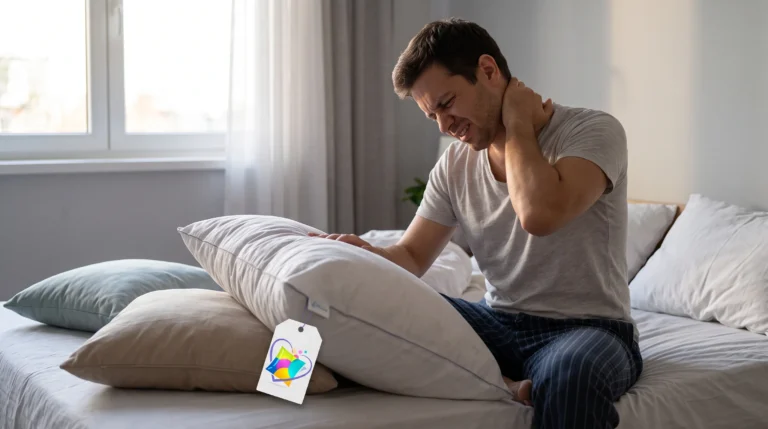
Stacking pillows lifts the head but leaves the shoulders flat, so the neck bends forward and the chin moves toward the chest. The studies above describe raising the head and trunk together, or keeping the head in a neutral, slightly extended position. A stack under the head alone does neither. It can also leave you with a sore neck in the morning, which is its own problem.
If you have been stacking pillows for years to "help" snoring and nobody has noticed a difference, that is useful information, not a failure. It suggests either your snoring is not strongly positional, or the stack is changing the wrong thing.
Is your snoring the kind a pillow can touch?
This is the part most pillow pages skip, and it is the decision that saves you from buying the wrong thing. We cannot assess anyone's snoring, but a few observations help sort which bucket you are probably in before you talk to a doctor or spend money.
| What you or a bed partner notices | What it points to | Can a pillow help? |
|---|---|---|
| Snoring is loud on your back and quieter or gone on your side | Positional snoring | Possibly, by supporting side sleeping or a better head position |
| Snoring is the same in every position | Something other than position | Unlikely to make much difference |
| Snoring is worse after alcohol or with a cold or blocked nose | Relaxed tissue or nasal blockage, both on Cleveland Clinic's list | Not the main factor; the cause is elsewhere |
| Pauses in breathing, gasping, choking, daytime sleepiness | Possible sleep apnea, per the NHS | Not a pillow question. See a doctor first |
A partner's account over a few nights, or a sleep-sound recording app, can show whether the noise changes when you roll over. Notice the direction of the evidence: a pillow only earns a place if position clearly matters.
Pillow height for snoring: the practical side
If your snoring does seem positional, pillow height is worth checking, because an unsuitable one can work against the position you are aiming for.
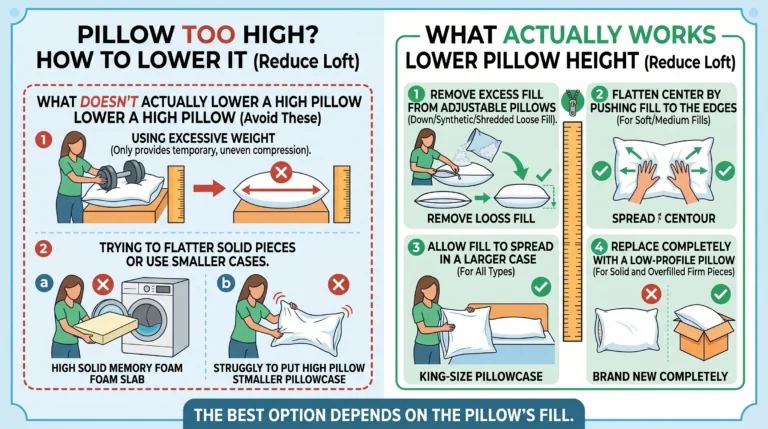
- Side sleepers: the gap between the side of your head and the mattress is set by your shoulder width. A pillow that is too flat lets the head drop toward the mattress; one that is too thick tilts it up. Either can make side sleeping uncomfortable enough that you roll onto your back during the night, which undoes the point.
- Back sleepers: a pillow high enough to push the chin down is the opposite of the "sniffing position" the review describes. A lower pillow, or a wedge that raises the upper body, is the version the research is about.
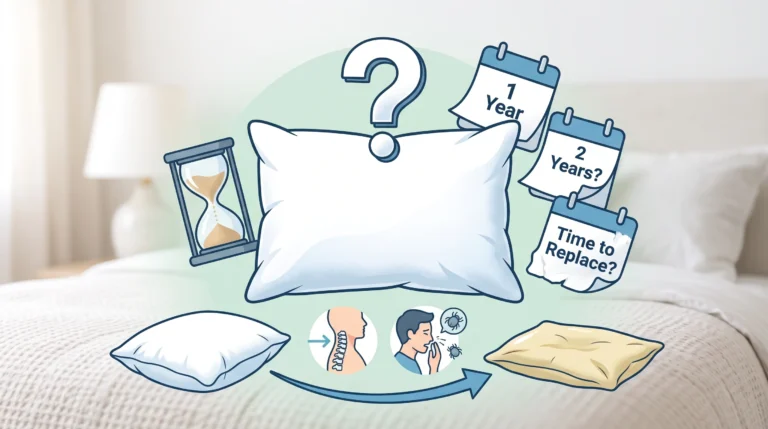
- Old, flattened pillows: fill breaks down and loses height over time. If your pillow has gone flat, the height you think you are sleeping on may not be the height you are getting. Our guide to how often to replace your pillow covers how long different fills last, and how to fluff a pillow explains which fills can be restored and which cannot.
None of this is a treatment. It is simply making sure the pillow is not the thing pushing you onto your back or into an awkward head angle.
Where a pillow is the wrong tool
It is just as useful to know what a pillow will not reach:
- Alcohol and sleeping pills. The NHS lists drinking too much alcohol and taking sleeping pills among things to avoid, because they can make snoring worse. A pillow does not change that.
- A blocked nose. Cleveland Clinic lists nasal congestion from allergies or colds as a cause. If you only snore when congested, the pillow is not the variable. If allergies are part of the picture, keeping bedding clean is sensible housekeeping, and pillow care basics covers washing and protecting pillows, but the congestion itself is a question for a doctor or pharmacist.
- Anatomy. Large tonsils, a deviated septum or other structural causes need a clinician's assessment.
- Sleep apnea. No pillow is a treatment for it, and the NHS and Cleveland Clinic both point to a doctor when the warning signs above are present.
A note on "anti-snoring" pillow claims
Pillows marketed for snoring range from shaped foam to wedges to powered "smart" pillows. We do not review or recommend products on this site, and we did not test any. What we can say is that much of the published evidence in this area comes from small studies, and at least one in-home study of inclined sleeping (published in JMIR Formative Research in 2022, with 25 participants) was funded by the company that supplied the adjustable bed bases. That does not make the findings wrong, but it is a good reason to read "clinically proven" claims carefully, and to check a return policy before buying anything on the strength of one.
FAQ
Does a pillow for snoring really work?
It can help some people whose snoring is positional, meaning it is worse on their back. A 2024 systematic review found snorers had the shortest and fewest snoring events when lying on their side. A pillow does not help snoring caused by alcohol, congestion, anatomy or sleep apnea.
Is it better to use two pillows to stop snoring?
Stacking pillows lifts only the head, which bends the neck forward. The research on elevation describes raising the head and upper body together, for example with a raised head of the bed or a wedge. A stack is a different thing and can also cause neck discomfort.
What pillow height is best for snoring?
There is no single number. For side sleepers, the right height fills the space set by the shoulder so the head stays level. For back sleepers, a pillow that pushes the chin toward the chest works against the aligned head position described in the research.
Can a pillow help with sleep apnea?
No pillow is a treatment for sleep apnea. The NHS lists breathing that stops and starts, gasping or choking noises, and daytime sleepiness as possible signs of sleep apnoea that warrant seeing a GP. Talk to a doctor if any of those apply.
Why do I snore more on my back?
When you lie on your back, gravity pulls the tongue and soft tissues toward the back of the throat, narrowing the airway. Cleveland Clinic lists back sleeping as one risk factor for snoring, and the NHS suggests side sleeping as one thing to try.
A pillow is a small lever on a narrow kind of snoring. If position clearly changes your snoring, the right height and shape can support the position that helps. If it does not, or if there are pauses, gasps or daytime exhaustion, the most useful next step is a doctor, not a new pillow.