Shoulder Pain From Sleeping on Side: Pillow Checks
Short answer: shoulder pain from sleeping on side has more than one possible cause, and the pillow is only a small part of the picture. MedlinePlus, the U.S. National Library of Medicine's health site, describes pain "at rest or at night, such as when lying on the affected shoulder" as a symptom of rotator cuff problems, and lists "sleeping on the same arm each night" among their causes. Pillow and position checks can show you what changes while you sleep, and that's useful to bring to a clinician. They can't diagnose or repair a shoulder. MedlinePlus advises contacting a provider for shoulder pain lasting more than 2 to 4 weeks, even after home treatment.
Check this first: when shoulder pain needs a doctor, not a pillow
Before any pillow detail, the warning signs. MedlinePlus's shoulder pain page (reviewed September 2, 2025, read September 24, 2026) says:
- "Sudden left shoulder pain can sometimes be a sign of a heart attack. Call 911 or the local emergency number if you have sudden pressure or crushing pain in your shoulder, especially if the pain runs from your chest to the left jaw, arm or neck, or occurs with shortness of breath, dizziness, or sweating."
- Emergency care is also warranted if "you have just had a severe injury and your shoulder is very painful, swollen, bruised, or bleeding."
The same page lists reasons to contact your provider:
- "Shoulder pain with a fever, swelling, or redness"
- "Pain for more than 2 to 4 weeks, even after home treatment"
MedlinePlus's page on rotator cuff problems adds: "Contact your provider if you have ongoing shoulder pain. Also contact your provider if symptoms do not improve with treatment."
A doctor or physical therapist is the right person to work out what's going on in the joint. Everything below is about the pillow and sleep position side of the question, which is the part we can speak to. None of it is a diagnosis or a treatment.
Why lying on your side can involve the shoulder
MedlinePlus's shoulder pain page names the most common cause of shoulder pain as rotator cuff tendons becoming "trapped under the bony area in the shoulder," where "the tendons become inflamed or damaged." It calls this rotator cuff tendinitis or bursitis.
Night pain is part of how those problems show up. The MedlinePlus rotator cuff problems page (reviewed September 2, 2025, read September 24, 2026) says that "over time, there may be pain at rest or at night, such as when lying on the affected shoulder," and that "rotator cuff tendon tears often cause pain at night. The pain may even wake you." Among the causes it lists are "sleeping on the same arm each night" and "poor posture over many years."
That's the honest frame for this whole article. Pain when you lie on a shoulder can be a sign of something in the shoulder, not just a sign of a bad pillow. Sleep position may matter, but the pain can also be telling you about a problem that was there before you lay down.
What the research says about shoulder pain from sleeping on side
Two studies come up again and again on this topic, and they point in different directions. That's worth knowing before anyone sells you a pillow as the fix.
Kempf and Kongsted, Journal of Manipulative and Physiological Therapeutics, 2012. The researchers asked 83 adults with pain in one shoulder, recruited from 10 chiropractic clinics, how they slept. Among those who slept mostly on one side, 67% lay on the painful shoulder. Patients also tended to turn away from their partner at night. The authors were careful about what this means: "It is unknown whether the observed associations are causal," but they suggested it was worth investigating whether changing sleep position, possibly just by switching sides of the bed, helps.
Holdaway and colleagues, BMC Musculoskeletal Disorders, 2018. This study looked at 761 workers, using a questionnaire on sleep positions and shoulder pain plus a physical exam for rotator cuff tendinopathy. The result surprised the researchers: the sleep position "anticipated to have the highest risk" was "paradoxically associated with a decreased prevalence" of shoulder pain. They offered one possible explanation: people prone to shoulder pain "may have learned to avoid sleeping in the predisposing position." They concluded that longer-term studies are needed.
| Kempf and Kongsted (2012) | Holdaway and colleagues (2018) | |
|---|---|---|
| Who | 83 chiropractic patients with pain in one shoulder | 761 workers |
| Finding | Most one-side sleepers lay on the painful side | The position expected to be riskiest was linked to less pain |
| Design | Cross-sectional: a snapshot, not cause and effect | Cross-sectional: a snapshot, not cause and effect |
| Authors' caution | Unknown whether the link is causal | Possible confounding; longitudinal studies needed |
Put together: there's a plausible link between the side you sleep on and the shoulder that hurts, but neither study shows that sleep position causes shoulder pain, and neither tested pillows at all. We didn't find a trial showing that any pillow resolves shoulder pain in side sleepers.
The pillow and position checks
These checks don't fix anything. They turn "my shoulder hurts in the morning" into specific observations, which is what a clinician will want to hear. A week of notes is more useful than a guess.
| Check | What to notice | Why it's worth noting |
|---|---|---|
| Which shoulder hurts | The one you lie on, or the top one | It separates the shoulder under your weight from the one resting on top |
| Which side you wake on | Whether it's the painful side, most nights | Kempf and Kongsted found most one-side sleepers lay on the painful shoulder |
| Where your arm ends up | Under the pillow, above your head, or tucked under your body | It's an easy detail to report and hard to remember later |
| Head position on the pillow | Whether your head sits roughly level with your spine, or tips down or up | A pillow that's too flat or too high changes the angle of your neck and upper body |
| Pillow condition | Whether it has flattened, clumped or stopped springing back | A worn pillow gives less height than it did when new |
| Mattress feel | Whether your shoulder sinks in or presses hard against the surface | The mattress decides how far the lower shoulder drops |
| Side of the bed | Whether you turn away from a partner onto one side | Kempf and Kongsted found 76% slept on the side opposite their partner |
Pillow height for side sleepers
The pillow's job for a side sleeper is to fill the space between the mattress and your head, so your head doesn't tip toward the mattress or get pushed up toward the ceiling. That space depends on your shoulder width and how far your shoulder sinks into the mattress, which is why there's no single correct height. A useful check is simple: lying on your side, is your head roughly in line with the rest of your spine?
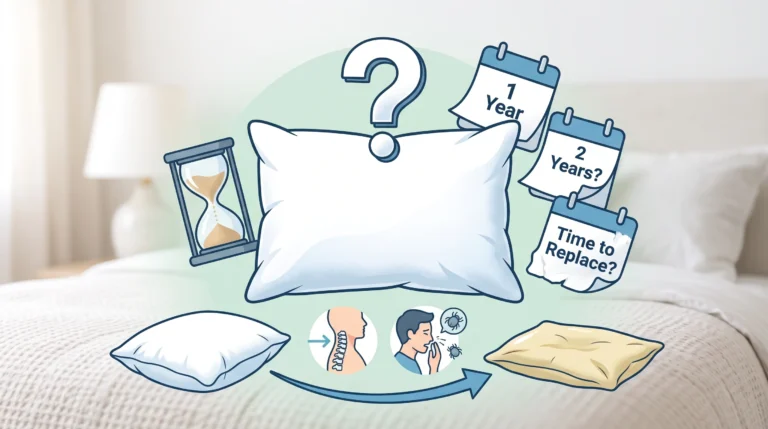
Pillows lose height with age. Fill compresses, clumps and stops recovering, so a pillow that fit well a few years ago may not now. Our guide to how often to replace your pillow explains why the answer depends on the fill. If the pillow has simply flattened, fluffing it can restore some loft to down, feather and fiber fills, though not every pillow type recovers that way.
Keep in mind the limit here: getting the pillow height right is about comfort and alignment. It isn't a proven treatment for shoulder pain, and a better-fitting pillow won't repair a tendon.
What MedlinePlus suggests for sleeping with a sore shoulder
For people dealing with rotator cuff problems, MedlinePlus's rotator cuff self-care page (reviewed June 4, 2025, read September 24, 2026) says: "When you sleep, lie either on the side that is not in pain or on your back. Resting your painful shoulder on a couple of pillows may help."
That's the most specific sourced sleep guidance we found, and it's worth noticing that it's about using pillows to support the arm and shoulder, not about finding a special head pillow. A doctor or physical therapist can tell you whether it applies to your shoulder and what else might help.
What a pillow can't do
A pillow can change how your head and upper body rest. It can't:
- repair an inflamed or torn rotator cuff tendon
- tell you whether pain is from the shoulder, the neck or somewhere else
- replace an exam when pain lasts, worsens or comes with other symptoms
Be wary of any pillow marketed as a cure for shoulder pain. The research on sleep position is mixed, and we found no research showing a pillow resolves it. If your pillow is old, flat or clearly the wrong height, replacing it is reasonable for comfort. If the shoulder still hurts, that's information about the shoulder.
Bringing your notes to an appointment
If you do see a doctor or physical therapist, the checks above make a short, useful summary: which shoulder hurts, which side you wake on, where your arm tends to end up, how long the pain has lasted, whether it wakes you, and whether it's getting better or worse. It's also worth mentioning any recent injury and anything that makes it noticeably better or worse during the day. That's the kind of detail that helps a clinician, and it's far more useful than a new pillow bought on a guess.
FAQ
Can sleeping on your side cause shoulder pain?
It may contribute. MedlinePlus lists "sleeping on the same arm each night" among causes of rotator cuff problems, and a 2012 study found most one-side sleepers with shoulder pain lay on the painful side. A larger 2018 study found a mixed picture, and neither showed cause and effect.
Why does my shoulder hurt more at night?
MedlinePlus says rotator cuff problems can cause pain at rest or at night, including when lying on the affected shoulder, and that tears often cause pain that can wake you. Night pain that keeps happening is a reason to talk to a provider.
What is the best sleeping position for shoulder pain?
For people with rotator cuff problems, MedlinePlus suggests lying on the side that isn't painful or on your back, and notes that resting the painful shoulder on a couple of pillows may help. A clinician can advise on your specific shoulder.
Can a new pillow fix shoulder pain from side sleeping?
We found no research showing that it can. A pillow at the right height can help keep your head in line with your spine, and a worn-out pillow may be worth replacing for comfort. Ongoing pain calls for a provider, not a new pillow.
When is shoulder pain an emergency?
MedlinePlus says sudden pressure or crushing pain in the shoulder, especially if it runs from the chest to the left jaw, arm or neck, or comes with shortness of breath, dizziness or sweating, can be a sign of a heart attack and warrants calling 911.
Shoulder pain from sleeping on your side sits right where a pillow question meets a medical one. Check the pillow, notice the position, and write down what you find. Then let a doctor or physical therapist decide what the shoulder needs, especially if the pain has lasted more than a couple of weeks or keeps waking you up.