Buckwheat Pillow Pros and Cons: An Honest Look
Short answer: the main buckwheat pillow pros and cons are simple. On the plus side, a buckwheat pillow is firm, holds its shape under your head, lets air move between the hulls, and lets you add or remove fill to change the height. On the minus side, it is heavy, noisy at first, awkward to clean, and too firm for many people. One popular claim, that buckwheat resists dust mites and suits allergy sufferers, is not supported by the one study we found that measured it.
Most of the pages ranking for this question are written by companies that sell buckwheat pillows or earn from links to them. This one sells nothing. It lays out the trade-offs, then looks at the two places where the claims and the evidence pull apart: allergies and temperature.
What a buckwheat pillow actually is
A buckwheat pillow is a fabric shell filled with buckwheat hulls, the hard outer casings of the buckwheat seed left over after the seed is removed. The hulls are small, rigid and roughly triangular, so they do not pack flat. They shift and lock around whatever presses on them, which is why the pillow feels a bit like a very firm beanbag.
Most buckwheat pillows have a zipper on the shell so the owner can pour hulls in or out. That zipper is behind most of the pros and several of the cons below. These pillows are not new: the review we cite later notes they have been popular in China and Korea for a long time and are now used much more widely.
Buckwheat pillow pros and cons at a glance
| Pros | Cons | |
|---|---|---|
| Support | Firm, holds its shape through the night | Too firm for people who like a soft, sinking pillow |
| Adjustability | Height changes by adding or removing hulls | Getting the height right takes some trial and error |
| Airflow | Gaps between hulls let air move | Cooling claims come mostly from sellers, not independent tests |
| Sound | None | Hulls crunch and rustle when you move |
| Weight | Stays where you put it | Noticeably heavier than a typical pillow |
| Cleaning | Shell can usually be washed once emptied | Hulls must be removed first and cannot be washed in water |
| Allergies | Hulls are a plant material, not animal fiber | Buckwheat is a known allergen; one study found high endotoxin on new pillows |
The pros, explained
Firm, steady support
Because the hulls interlock instead of compressing like foam or polyester fiber, a buckwheat pillow does not slowly flatten under the weight of your head during the night. People who dislike waking up on a pillow that has sagged often like this. We found no clinical evidence that buckwheat treats neck or back pain, whatever some sellers imply. If you have persistent neck or shoulder pain, a doctor or physiotherapist is the right person to ask.
Adjustable height
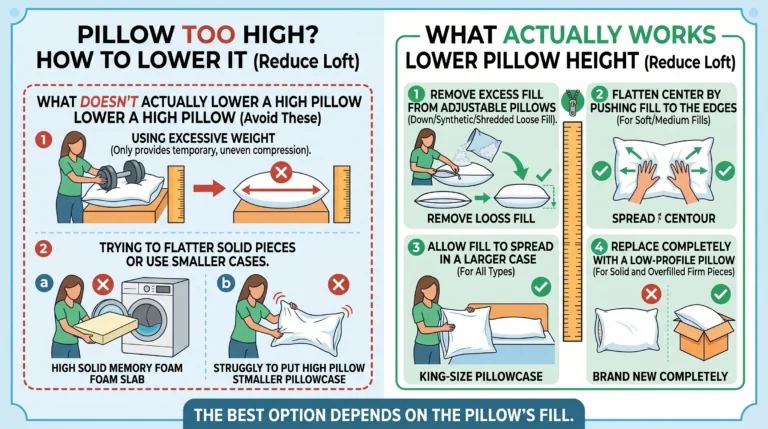
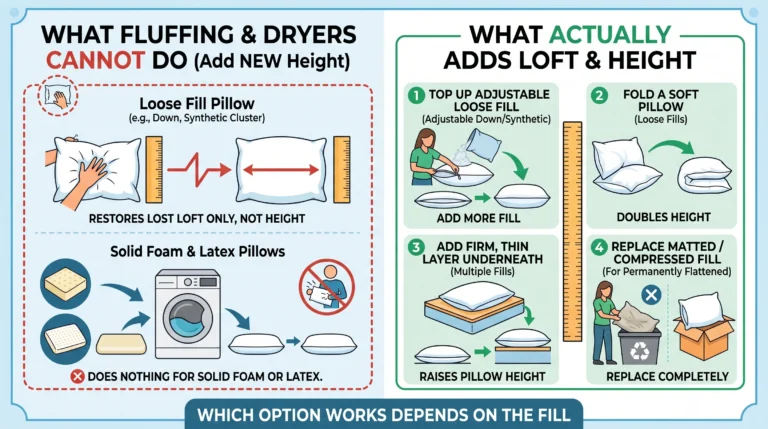
This is the strongest practical argument for buckwheat. Removing a few handfuls of hulls lowers the pillow; adding them back raises it. Height, or loft, matters more to how a pillow fits than almost anything else. Side sleepers usually need more height to fill the gap between the shoulder and the head, back sleepers less, and front sleepers the least. A buckwheat pillow lets one pillow cover that range.
Airflow between the hulls
The hulls do not pack into a solid mass, so there are always small air pockets between them. That is the basis for the widespread claim that buckwheat sleeps cool. The mechanism is reasonable. How much difference it makes for a real sleeper is less clear, as the section on temperature explains.
A plant-based fill
Buckwheat hulls are a by-product of processing buckwheat seed, so the fill is plant material rather than petroleum-based foam or fiber, or animal down. For shoppers who care about that, it is a genuine point in its favor.
The cons, explained
Firmness is not for everyone
The same firmness that some sleepers love is the most common complaint. If you like to sink into a soft pillow, a buckwheat pillow will probably feel hard, even after you take hulls out. Removing fill lowers the pillow; it does not make the hulls softer.
Noise
Hulls rub against each other every time you move your head. Some people stop noticing it within days; light sleepers may not. Makers generally say the sound softens as the hulls wear in, but that is a seller's claim rather than something we could verify.
Weight
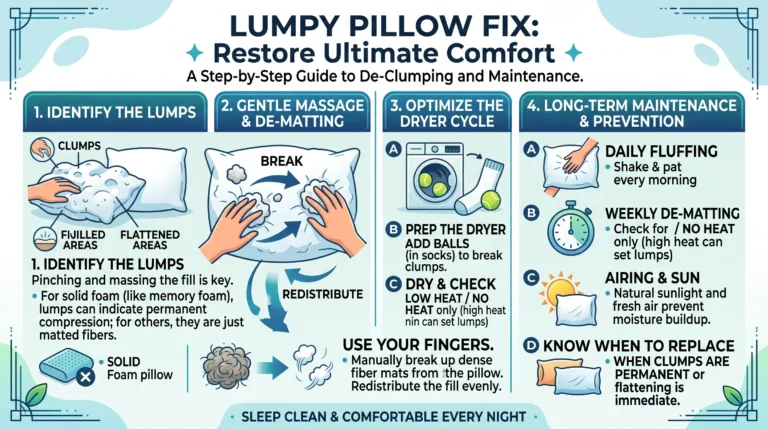
A full buckwheat pillow is much heavier than a polyester or down pillow of the same size. That helps it stay put on the bed, but it makes it awkward to move, fluff or prop up against a headboard, since the hulls slide to the bottom when the pillow is upright. Our guide on how to fluff a pillow explains why some pillows can be fluffed and others cannot; buckwheat is closer to the second group, since you reshape it by hand rather than fluff it.
Cleaning takes more work
You cannot put a filled buckwheat pillow in the washing machine. The usual approach, per most makers' care instructions, is to empty the hulls into a container, wash the shell, dry it fully, and refill. The hulls themselves are not washed in water. Our guide to washing pillows in a washing machine covers which fills can and cannot take a machine cycle, and our pillow care guide covers everyday upkeep by fill type.
Where sources disagree: allergies and dust mites
This is the claim that deserves the closest look. Many buckwheat pillow pages say the hulls resist dust mites and make the pillow a good choice for people with allergies. We could find only one study that measured mite allergen on buckwheat pillows directly, and its results do not back that up.
In a 2004 study in the Journal of Korean Medical Science (read September 27, 2026), Nam, Park, Crane and Siebers compared new buckwheat and new synthetic pillows. No house dust mite allergen (Der f 1) was found on either type when new. After three months of use, the levels were similar on both: a geometric mean of 1.16 micrograms per gram on buckwheat and 1.08 on synthetic. In other words, in that study buckwheat did not keep mite allergen away any better than a synthetic pillow.
The same study found something the sellers rarely mention. Endotoxin, a bacterial substance the authors link to worse asthma in allergy-prone people, was far higher on new buckwheat pillows: a geometric mean of 60,950 EU/g against 4,887 EU/g on new synthetic pillows. The authors concluded that "in Korea new buckwheat pillows contain very high levels of endotoxin" and suggested atopic asthmatics "should perhaps avoid use of such pillows." It is a single study of pillows sold in one country, so it is not the final word, but it is more evidence than the marketing claims come with.
Buckwheat is also a recognized allergen in its own right. A 2021 review by Norbäck and Wieslander in the journal Plants (read September 27, 2026) says pillows filled with buckwheat husk "can cause domestic exposure to airborne buckwheat allergens when sleeping on the pillows," and describes reported cases of children whose night-time asthma was linked to buckwheat husk pillows. The reported cases are small, but the direction is consistent.
None of this means a buckwheat pillow will cause a problem for any particular person. It means "good for allergies" is not a safe assumption. Anyone with asthma, a known buckwheat allergy, or allergy symptoms that seem worse at night should talk to a doctor or allergist before switching.
Where sources disagree: is it really cool?
On temperature, almost every page we read says buckwheat sleeps cool, and the airflow explanation makes sense. The catch is who is saying it. Nearly all of those pages come from pillow makers or from review sites that earn from pillow links, and we found no independent, published measurement comparing the surface temperature of buckwheat with other fills. Some sellers go further and describe the same pillow as cool in summer and warm in winter, which is hard to square as a single physical property.
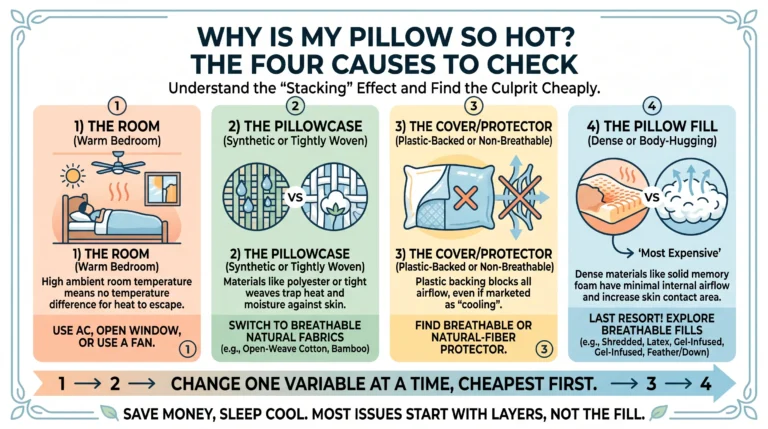
A fair reading is this: buckwheat does not trap heat the way a solid slab of foam can, so it is a reasonable option for someone who sleeps warm. How much cooler it feels depends on the room, the pillowcase, how full the pillow is, and the person. Treat specific numbers about "degrees cooler" as marketing unless the source shows how they were measured.
Who a buckwheat pillow suits, and who it does not
A buckwheat pillow tends to suit people who:
- like a firm pillow that does not move or flatten during the night
- want to fine-tune the height of one pillow
- sleep warm and dislike solid foam
- are happy to empty and refill a pillow to wash it
It tends not to suit people who:
- like a soft, squashy pillow
- are light sleepers bothered by rustling
- have asthma, a buckwheat allergy or night-time allergy symptoms, without first checking with a doctor
- want a pillow they can throw straight into the washing machine
How long a buckwheat pillow keeps its shape depends on use, and hulls can be topped up as they break down. Our guide on how often to replace your pillow explains the signs that any pillow is past its best.
FAQ
What are the main pros and cons of a buckwheat pillow?
The main pros are firm, steady support, adjustable height, airflow between the hulls and a plant-based fill. The main cons are firmness, noise, weight and harder cleaning. Allergy claims are weaker than sellers suggest.
Are buckwheat pillows good for people with allergies?
Not necessarily. A 2004 study in the Journal of Korean Medical Science found similar dust mite allergen levels on buckwheat and synthetic pillows after three months, and much higher endotoxin on new buckwheat pillows. Buckwheat is also a known allergen. Ask a doctor or allergist first.
Do buckwheat pillows really stay cool?
The hulls leave air gaps, so they do not trap heat like solid foam. But most cooling claims come from sellers, and we found no independent published measurement.
Can you wash a buckwheat pillow?
Not whole. Makers generally advise emptying the hulls, washing the shell, drying it fully, then refilling. The hulls are not washed in water.
Why is my buckwheat pillow so noisy?
The hulls rub against each other when you move. Many people get used to it; light sleepers may not.
A buckwheat pillow is a good tool for the right sleeper: firm, adjustable and airy. Just weigh the allergy question on the evidence, not the label.