Talalay vs Dunlop Latex Pillow: What the Label Means
Short answer: in the Talalay vs Dunlop latex pillow question, the two words name manufacturing processes, not different materials. Dunlop latex is whipped, poured into a mold and baked, which tends to make it denser and firmer, with the bottom side slightly firmer than the top. Talalay adds vacuum and flash-freezing steps before baking, which gives a lighter, more even, springier foam. Neither word tells you whether the latex is natural, blended or synthetic. That's a separate line on the label.
Most pages comparing the two are written by companies that sell one or both. This one isn't. It explains what each process does, how that tends to change the pillow, and what to look for on a label so the words mean something.
What latex foam is, in one paragraph
Latex pillows are made from rubber foam. Natural latex comes from the sap of rubber trees; synthetic latex is manufactured rubber; blended latex mixes the two. Whichever raw material is used, the liquid has to be turned into a solid foam, and there are two main ways of doing that: Dunlop and Talalay. So a pillow can be natural Dunlop, natural Talalay, blended Talalay, and so on. Keeping those two ideas apart (the raw material and the process) clears up most of the confusion around latex labels.
How Dunlop latex is made
Dunlop is the older and simpler process. Savvy Rest, a maker of latex bedding that uses both types, describes it on its Dunlop and Talalay page (read September 27, 2026): "The thick rubber sap, or serum, is whipped into a froth in a centrifuge, poured into a mold, covered, and steam baked."
Because the foam is baked without any step that holds the mixture in suspension, natural sediments settle during the process. Savvy Rest says this makes "every Dunlop layer slightly firmer on its bottom side," and describes Dunlop as "denser" and "firmer overall than Talalay." It also notes that "Dunlop is generally heavier."
For a pillow, that density matters in two places. A solid Dunlop pillow tends to feel firm and stable. And because denser pieces hold their shape, Dunlop is often used as shredded latex fill in adjustable pillows.
How Talalay latex is made
Talalay adds steps. Talalay Global, a Talalay latex manufacturer, lists eight on its process page (read September 27, 2026). The mixture is "aerated and injected into an aluminum pincore mold." Then: "The mold is sealed, and a vacuum is used to pull and fill the mold with liquid latex." Next, "the formula is flash frozen at a temperature of -22 degrees Fahrenheit." After that, "the latex is heated to 220 degrees Fahrenheit," which "physically changes the product from a liquid to a solid state," followed by washing, vulcanizing and testing.
Talalay Global calls the vacuum and freezing steps unique to the Talalay process. Savvy Rest describes the result as "a more consistent cell structure from top to bottom and edge to edge," and says "Talalay has a wider range of firmness grades."
The freeze is the step that makes the practical difference. Locking the foam in place before it sets stops particles from settling, so a Talalay pillow tends to feel the same on both sides and throughout.
Talalay vs Dunlop latex pillow: side by side
| Dunlop | Talalay | |
|---|---|---|
| Process | Whipped, poured, covered, steam baked | Poured, vacuum-expanded, flash frozen, then baked |
| Structure | Denser; bottom side slightly firmer | More even from top to bottom |
| General feel | Firmer, more solid, less bounce | Lighter, springier, softer surface |
| Weight | Generally heavier | Generally lighter |
| Firmness range | Narrower | Wider range of grades, per Savvy Rest |
| Common pillow uses | Solid firm pillows; shredded fill | Solid contour and soft pillows |
| Tells you the raw material? | No | No |
The feel descriptions are generalizations from how makers and reviewers describe the two. Individual pillows vary a lot, because firmness also depends on the recipe, the density the maker chose, the pillow's shape, and whether the latex is solid or shredded.
What the label does and doesn't tell you
This is the part most comparisons skip. "Talalay" or "Dunlop" on a label tells you how the foam was made. It does not tell you:
- Whether the latex is natural, blended or synthetic. The process name and the raw material are separate facts. Look for a separate statement of the latex type and, ideally, the proportion.
- Whether it's organic. Organic claims are a separate certification. The Global Organic Latex Standard (GOLS), run by the certification body Control Union, covers "products made out of organically grown natural rubber latex." According to Control Union's GOLS page (read September 27, 2026), labeling a final product as GOLS requires that all raw materials, other than approved accessories, meet its organic-origin requirements.
- How firm the pillow is. Both processes can produce softer and firmer foam. A firmness rating or description from the maker says more than the process name.
- The pillow's height or shape. Loft and contour are design choices, and they matter more to fit than the process.
So when two pillows are both called "latex," the useful questions are: which process, which raw material, what firmness, what height, solid or shredded?
Which one suits which sleeper?
We found no clinical evidence that one process is better for sleep or for any body part, and a pillow can't treat neck or shoulder pain. What the processes change is feel, and feel is personal. As a general guide:
- If you like a firm, stable pillow that barely moves, the denser character of Dunlop is the usual match.
- If you like a pillow with more give and bounce, Talalay's lighter structure is the usual match.
- If you want to adjust the height, shredded latex lets you add or remove fill.
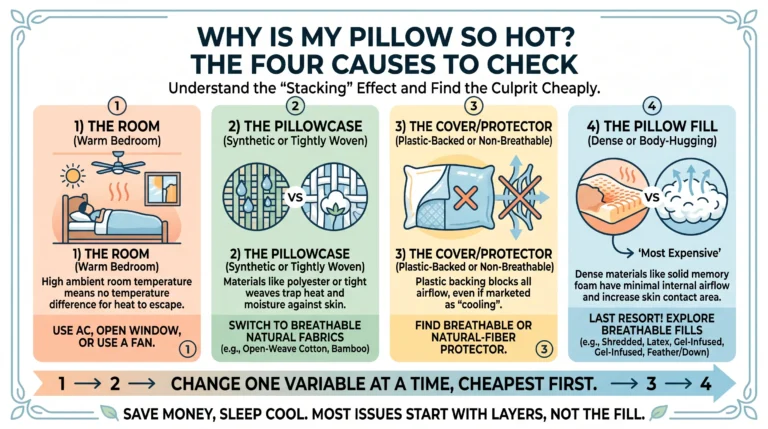
- If you sleep warm, Talalay is often described as more breathable because of its even, open structure, though room temperature, the cover and the pillowcase also matter a lot.
Height matters more than process for most people. Side sleepers usually need more loft than back sleepers, and front sleepers usually need the least. If you have persistent neck or shoulder pain, a doctor or physiotherapist is the right person to ask, not a pillow label.
A note on latex allergy
Natural latex comes from rubber tree sap. Anyone with a known latex allergy should talk to a doctor or allergist before choosing a latex pillow of either type, since the process name doesn't change the raw material. It's also worth asking the maker exactly what the pillow contains.
Caring for latex pillows
Solid latex, Dunlop or Talalay, usually isn't made for a washing machine; the common approach is to wash the removable cover and follow the maker's care label for the core. Our pillow care guide covers cleaning, drying and upkeep by fill type, and our guide to washing pillows in a washing machine explains which fills can and can't take a machine cycle. Latex is often described as long-lasting, but how long any pillow stays supportive depends on the fill and how it's used, as our guide on how often to replace your pillow explains.
FAQ
What is the difference between Talalay and Dunlop latex pillows?
They're two ways of making latex foam. Dunlop is whipped, poured and baked, which makes it denser and firmer, with a slightly firmer bottom. Talalay adds vacuum and flash-freezing steps, which give a lighter, more even, springier foam.
Is Talalay or Dunlop latex softer?
Talalay is generally described as softer and springier, and Savvy Rest notes it comes in a wider range of firmness grades. Dunlop is generally described as denser and firmer. The specific pillow's firmness rating matters more than the process.
Is Talalay latex natural?
It can be, but the process name alone doesn't say. Check the label for the latex type (natural, blended or synthetic) separately from the process name.
Which latex is better for shredded pillows?
Shredded latex fill is often Dunlop, because its denser pieces hold their shape. Talalay is more often seen in solid pillows, though makers vary.
Can I wash a latex pillow?
Solid latex pillows usually aren't machine washable. Wash the removable cover and follow the maker's care label for the core.
Talalay and Dunlop are useful words once you know they describe a process. Read them alongside the latex type, the firmness and the height, and a latex pillow label starts to tell you what you actually need to know.