Is Sleeping With Two Pillows Bad? When It Helps or Hurts
Short answer: sleeping with two pillows is not bad in itself. What matters is where the second pillow goes and why you need it. Two pillows stacked under your head can raise it well above the line of your spine, and the NHS advice for neck pain is to keep your head "the same height as the rest of your body." A second pillow used under the upper back, or somewhere other than your head, is a different thing. And if you need more pillows because you can't breathe comfortably lying flat, MedlinePlus says that is a reason to call your provider.
Check this first: when needing more pillows is a symptom
Most people who sleep on two pillows do it out of habit or because one pillow has gone flat. But there is one situation where the pillow count is information about your health, not your bedding, so it comes first.
MedlinePlus, the U.S. National Library of Medicine's health site, has a page on breathing difficulty while lying down (reviewed January 1, 2025, read September 27, 2026). It describes the condition as a problem "breathing normally when lying flat" and says it is a common complaint in people with some types of heart or lung problems. It also notes that it can be hard to spot: people may only notice it "when they realize that sleep is more comfortable with lots of pillows under their head, or their head in a propped-up position."
MedlinePlus's guidance is direct: "If you have any unexplained difficulty in breathing while lying down, call your provider." It adds that a provider may ask how many pillows you need to breathe comfortably and whether you have ankle, foot or leg swelling.
So if you've gradually gone from one pillow to two, or two to three, because lying flat leaves you short of breath, that's a conversation for a doctor, not a pillow article. Everything below assumes you stack pillows for comfort, habit or a flat pillow, and that breathing isn't the reason.
Is sleeping with two pillows bad for your neck?
It can be, depending on how high the stack puts your head. The goal most guidance describes is simple: while you sleep, your head should sit roughly in line with the rest of your spine.
The NHS page on neck pain (last reviewed April 27, 2023, read September 27, 2026) puts it plainly. To help prevent neck pain, it says "when sleeping, make sure your head is the same height as the rest of your body." For easing existing neck pain, its self-care list includes "use a low, firm pillow." It also advises "do not sleep on your front" and "do not twist your neck when you're in bed."
Two full pillows stacked under the head work against that for many sleepers:
- On your back, a tall stack pushes your chin toward your chest, bending the neck forward all night.
- On your side, a stack taller than the gap between your shoulder and the mattress tilts your head up toward the ceiling, so the neck bends sideways.
- On your front, extra height turns and lifts the head even further, and the NHS already advises against front sleeping for neck pain.
None of this means two pillows will cause pain for everyone. It depends on your build, your mattress and how thick the pillows are. Two thin, soft pillows can end up lower than one thick firm one. The number of pillows is a rough stand-in for the real question, which is how high your head ends up.
The NHS page also says to see a GP if neck pain or stiffness does not go away after a few weeks, if painkillers have not worked, if you're worried about the pain, or if you have other symptoms such as pins and needles or a cold arm. Those signs point past the pillow.
Why people end up sleeping with two pillows
It helps to know why you stack, because the reason usually points to the fix.
One pillow has gone flat
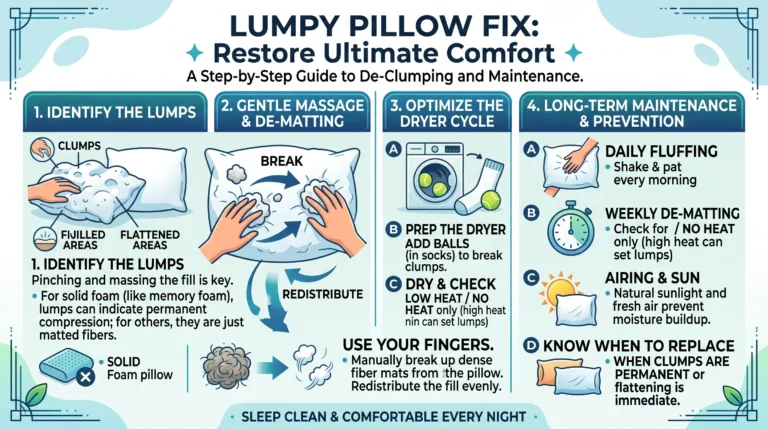
This is the most common reason. Fill compresses and clumps with age, so a pillow that once gave enough height stops doing it, and a second pillow gets added to make up the difference. Two worn pillows rarely add up to one good one: they slide against each other, the gap between them shifts during the night, and the top one keeps collapsing into the bottom one. If this is you, the first question is whether the pillows are simply past their useful life. Our guide to how often to replace your pillow explains why the answer depends on the fill. Before replacing anything, it's worth trying to fluff the pillow back to shape, since down, feather and fiber fills can recover some loft, though foam cannot.
Reading, watching or sitting up in bed
Many people stack pillows to sit up, then fall asleep that way. The position that is comfortable for reading is usually much higher than the one that suits sleep. Pulling the extra pillow out before sleep separates the two uses.
Reflux or heartburn at night
Some people raise their head because of acid reflux. This is where the placement detail matters most, and it's covered in the next section.
Habit
Plenty of people have slept on two pillows since childhood and never thought about it. If you wake up comfortable with no stiffness, there may be nothing to fix.
When two pillows can help: it depends where they go
The same two pillows can do very different things depending on placement.
Reflux: the head and upper back, not just the head
The National Institute of Diabetes and Digestive and Kidney Diseases (NIDDK) lists lifestyle changes for acid reflux in adults on its GER and GERD treatment page (last reviewed July 2020, read September 27, 2026). One of them is "elevating your head during sleep by placing a foam wedge or extra pillows under your head and upper back to incline your body and raise your head off your bed 6 to 8 inches."
Notice the wording: under the head and upper back, to incline your body. That's a gentle slope that starts below the shoulders. Two pillows stacked only under the head produce something different: the body stays flat and the neck does the bending. If reflux is why you sleep propped up, the NIDDK description is the one to discuss with your doctor, who can say whether it suits you and what else to consider.
A second pillow for the body, not the head
Pillow and mattress guides commonly suggest a second pillow somewhere other than under the head: between the knees for side sleepers, or under the knees for back sleepers. These are comfort suggestions from companies that sell bedding. We did not find a trial showing they prevent or treat pain, so treat them as something to try for comfort, and ask a physiotherapist if you have back or hip pain.
Two stacked pillows vs other setups
| Setup | What it changes | What to watch for |
|---|---|---|
| Two pillows stacked under the head | Raises the head, often above the line of the spine | Chin tucked forward (back) or head tilted up (side) |
| One pillow under the head | Height depends entirely on that pillow's loft | A worn pillow may now be too low |
| Pillows under head and upper back, or a wedge | Inclines the upper body rather than bending the neck | The slope described for reflux by NIDDK |
| One under the head, one between the knees | Head height unchanged; second pillow supports the legs | Comfort suggestion from bedding guides, not a treatment |
| Extra pillows needed to breathe | Not a bedding choice | MedlinePlus: call your provider |
A simple one-week check
If you're not sure whether your two-pillow habit is a problem, a short experiment tells you more than any rule. It isn't a diagnosis. It's a way of turning a vague feeling into notes.
- Note the baseline. For two or three mornings on your usual two pillows, write down any neck stiffness on waking and whether it fades during the day.
- Look at the angle. Have someone look at you lying in your usual position, or use a mirror. Is your head roughly level with your spine, or tipped forward, up or sideways?
- Try one pillow. For the next few nights, sleep on the better of the two pillows alone. If it's clearly too flat, fold a thin towel under it to add a little height rather than a whole second pillow.
- Compare. Morning stiffness that improves with less height suggests the stack was too high. No change suggests the pillow count wasn't the issue.
If stiffness persists either way, or you notice pain, numbness or tingling, the NHS signs above apply, and a doctor or physiotherapist is the right person to see.
What a pillow can't do
A pillow, or two, can change the angle your head and neck rest at. It can't diagnose why your neck hurts, repair anything in the spine, or treat reflux or a breathing problem. If you need the extra height to feel able to breathe, that's the most important finding in this whole article, and it belongs with your provider. For everything else, the pillow question is really a height question: does your setup keep your head roughly in line with your body? Keeping the pillows themselves in good shape helps them hold that height, and our pillow care guide covers cleaning, drying and upkeep by fill type.
FAQ
Is it bad to sleep with two pillows under your head?
It can be if the stack lifts your head well above the line of your spine. The NHS advises keeping your head the same height as the rest of your body when sleeping. Two thin pillows may be fine; two thick ones often put the neck at an angle.
Is sleeping with two pillows good for acid reflux?
NIDDK lists raising the head 6 to 8 inches with a foam wedge or extra pillows under the head and upper back as a lifestyle change for reflux. The key detail is that the upper back is raised too, so the body inclines. Your doctor can advise whether it suits you.
Why do I need two pillows to breathe at night?
MedlinePlus says difficulty breathing when lying flat can be linked to some heart or lung problems, and that people sometimes notice it only because sleep feels easier with lots of pillows. It advises calling your provider about any unexplained breathing difficulty while lying down.
Should side sleepers use two pillows?
Bedding guides often suggest one pillow under the head and one between the knees. For the head, what matters is filling the gap between shoulder and mattress without tilting the head up. That may take one thick pillow or one thinner pillow, depending on your build.
Is one pillow better than two?
Not automatically. One well-fitting pillow often keeps the head at a better height than two worn ones stacked, but the right answer depends on your body, mattress and sleep position.
Two pillows are a habit, not a diagnosis. Check where your head ends up, notice how your neck feels in the morning, and let the pillow count follow the height you need. If the reason you stack is that lying flat makes breathing hard, skip the pillow shopping and talk to your provider first.