Can You Dry Clean Pillows? What to Know First
Physically, yes, most dry cleaners will accept a pillow. Whether you should is a different question. Down and feather pillows are the ones most often taken to a dry cleaner, but specialty pillow-cleaning services generally advise against it, because dry-cleaning solvents can be absorbed into the fill and are difficult to fully remove, and you then sleep with your face against that pillow for hours at a time. Memory foam and latex pillows should not be dry cleaned either, since solvents can degrade foam. Check the care label first. If it says "dry clean only," that instruction is coming from the manufacturer and should be followed; if it says machine washable, machine washing at home is the more transparent option.
What actually happens in a dry-clean cycle
Dry cleaning doesn't use water. It uses a solvent, most commonly perchloroethylene ("perc"), to dissolve oils and dirt out of fabric. That's effective for garments that can't tolerate water or agitation, like structured wool coats and delicate silk. Applied to a pillow, the same solvent has to reach and then be rinsed back out of the fill, not just the outer fabric shell, which is a much harder job on something as thick and enclosed as a pillow.
The real issue: what's left behind afterward
This is the part most people don't think about. The Environmental Working Group, an independent research and advocacy organization that has studied dry-cleaning chemical exposure, reports that garments retain a residual amount of solvent when they come out of the machine, and that this residue is why dry cleaners commonly recommend airing garments out in a well-ventilated space before wearing them. Perchloroethylene is classified by the U.S. National Toxicology Program as reasonably anticipated to be a human carcinogen, and inhaling it even in low concentrations is associated with irritation, headache, and dizziness. A jacket you air out for a day before wearing is one thing. A pillow you put your face directly against for seven or eight hours a night, night after night, is a meaningfully different exposure, which is the actual reason specialty pillow cleaners advise against dry cleaning down and down-blend pillows specifically, rather than sending them through a standard garment dry-clean process.
If you do decide to have a pillow dry cleaned, airing it out thoroughly, ideally outdoors and out of its plastic wrapping, for at least a few days before it goes back on your bed meaningfully reduces this exposure. It doesn't eliminate it entirely.
Dry cleaning versus professional wet cleaning
These two are easy to confuse, but they're different processes. Standard dry cleaning uses a chemical solvent instead of water. Professional wet cleaning, offered by some of the same cleaners, uses water along with specialized detergents and controlled, gentler machine cycles designed for items that can't handle an ordinary home wash, like a delicate down comforter. Wet cleaning avoids the solvent-retention issue entirely, since there's no solvent involved, and it's a reasonable question to ask a cleaner directly: "do you offer wet cleaning, not just dry cleaning, for pillows?" Not every cleaner does, but where it's available, it's a genuinely better fit for a pillow than solvent-based dry cleaning.
Whether it's even the right method, by fill
| Fill type | Dry cleaning | Better option |
|---|---|---|
| Down / feather | Technically possible, but generally not recommended because of solvent retention | Machine wash on a delicate or gentle cycle, or hand wash for pillows too large for a machine |
| Memory foam | No | Spot clean and hand wash the cover; the foam core is air-dried only, never submerged, never solvent-treated |
| Latex | No | Same as memory foam: spot clean, air dry, never machine wash, never dry clean |
| Polyester / fiberfill | Not necessary | Machine washable; dry cleaning adds cost and solvent exposure for no real benefit |
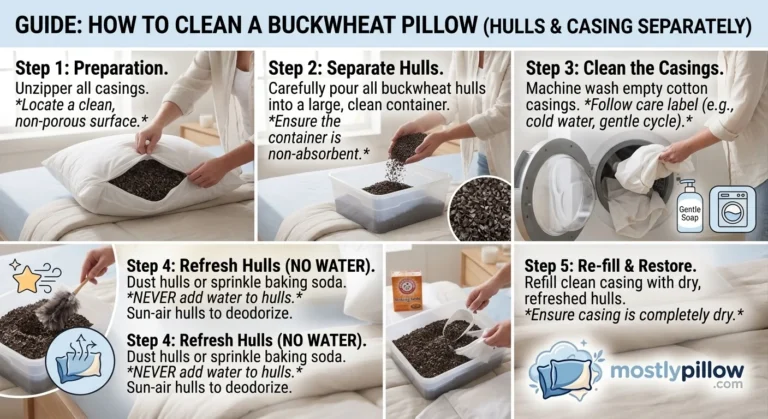
| Buckwheat | No | The casing can be washed separately; the hulls are never wetted or solvent-treated, just aired |
The full material-specific washing procedures are in Pillow Care 101, and the step-by-step for the fill that most often ends up at a dry cleaner is in How to Wash Down and Feather Pillows.
When dry cleaning is genuinely a reasonable choice
There's a real scenario where dry cleaning still makes sense: a large, expensive down pillow, no washing machine with enough capacity, and a willingness to air the pillow out thoroughly before it goes back on the bed. In that case, dry cleaning is a workable trade-off rather than an ideal method. What it should not be treated as is a default first choice over washing at home, and it should never be considered for memory foam or latex, where the solvent itself risks degrading the material rather than just leaving a residue.
What to do instead if you don't have a machine
A large down or feather pillow that won't fit a home washing machine doesn't have to go to a dry cleaner. Hand washing in a bathtub is the more transparent alternative, since you control exactly what goes into the water and can rinse until it runs clear. How to Wash Pillows Without a Washing Machine (Bathtub Method) covers the full process.
After the pillow comes home
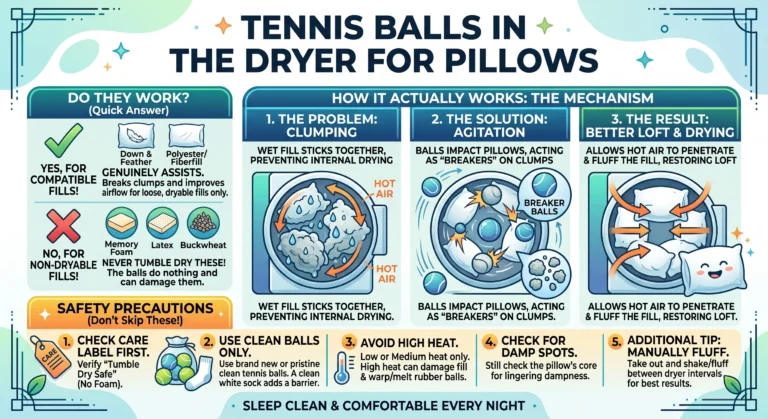
Whether a pillow has been dry cleaned or washed at home, it needs to be genuinely dry all the way through the fill before it goes back on the bed, not just dry on the outer surface. A pillow that goes into storage or back onto a bed while still damp at the core is the most common cause of a musty smell developing later. How to Get Smells Out of a Pillow covers what to do if that's already happened.
FAQ
Is it safe to dry clean a down pillow?
It's physically possible, but most specialty pillow-cleaning guidance advises against it because dry-cleaning solvents can be absorbed into the fill and are hard to fully remove, and you then sleep against that pillow for hours. Machine washing at home is generally the better-understood alternative.
Can memory foam or latex pillows be dry cleaned?
No. Dry-cleaning solvents can degrade foam and latex material. These fills are spot cleaned and air dried, never machine washed or solvent treated.
How long should I air out a dry-cleaned pillow before using it?
There's no universal figure, but longer is better, and outdoors in open air is better than indoors in a closed room. A few days of airing, out of the plastic wrapping, reduces residual solvent before the pillow goes back into regular use.
Why does my pillow's care label say dry clean only?
Some manufacturers specify dry cleaning because of the outer fabric or construction, not necessarily the fill. Follow the care label for your specific pillow, since it reflects what the manufacturer tested for that exact product.
Is dry cleaning better than washing a pillow at home?
Not generally. For fills that are machine or hand washable, washing at home avoids solvent exposure entirely and is usually the more transparent option. Dry cleaning is a fallback for pillows too large to wash at home, not a default first choice.